Quicklinks
Cooking Fuel and the Humanitarian Response in Haiti |
|
|
|
|
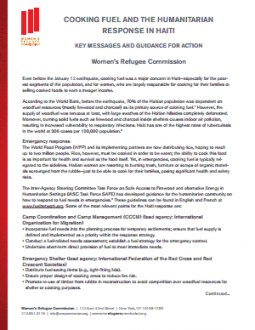
KEY MESSAGES AND GUIDANCE FOR ACTION Even before the January 12 earthquake, cooking fuel was a major concern in Haiti—especially for the poorest segments of the population, and for women, who are largely responsible for cooking for their families or selling cooked foods to earn a meager income. According to the World Bank, before the earthquake, 70% of the Haitian population was dependent on woodfuel resources (mostly firewood and charcoal) as its primary source of cooking fuel.1 However, the supply of woodfuel was tenuous at best, with large swathes of the Haitian hillsides completely deforested. Moreover, burning solid fuels such as firewood and charcoal inside shelters causes indoor air pollution, resulting in increased vulnerability to respiratory infections. Haiti has one of the highest rates of tuberculosis in the world at 306 cases per 100,000 population.2 Emergency responseThe World Food Program (WFP) and its implementing partners are now distributing rice, hoping to reach up to two million people. Rice, however, must be cooked in order to be eaten; the ability to cook this food is as important for health and survival as the food itself. Yet, in emergencies, cooking fuel is typically relegated to the sidelines. Haitian women are resorting to burning trash, furniture or scraps of organic materials scrounged from the rubble—just to be able to cook for their families, posing significant health and safety risks. The Inter-Agency Steering Committee Task Force on Safe Access to Firewood and alternative Energy in Humanitarian Settings (IASC Task Force SAFE) has developed guidance for the humanitarian community on how to respond to fuel needs in emergencies.3 These guidelines can be found in English and French at www.fuelnetwork.org. Some of the most relevant points for the Haiti response are: Camp Coordination and Camp Management (CCCM) (lead agency: International Organization for Migration)
Emergency Shelter (lead agency: International Federation of the Red Cross and Red Crescent Societies)
Environment and natural resource management
Food and Nutrition (lead agencies: WFP, UNICEF)
Health (lead agency: World Health Organization)
Information, Education and Communication (IEC)
Livelihoods, Development and Food Security (lead agency: UN Development Program)
Protection (lead agency: UN High Commissioner for Human Rights)
Medium- to long-term responseImmediate response is critical, but it is only part of the story. As the humanitarian community works with Haitians and their government to “build back better,” the Women’s Refugee Commission strongly recommends that ensuring safe access to appropriate household energy should be a key component of the medium- and long-term reconstruction strategy. This strategy should be based on the guidance created by the IASC Task Force SAFE for all humanitarian response clusters and agencies, recognizing their specific areas of expertise. Download this article as a PDF Notes |

Cooking Fuel and the Humanitarian Response in Haiti


International Rescue Committee
Watchlist on Children and Armed Conflict