
To support and uplift local experience and expertise, WRC partners with local researchers to produce our groundbreaking reports. These researchers often have deeply personal connections to, and unique takeaways from, the work. In this new series, we give them the floor to share their reflections.
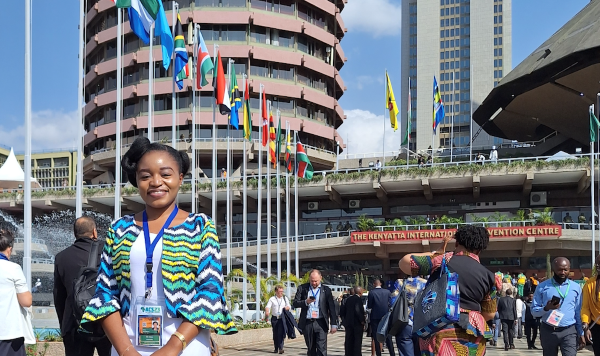
We previously spotlighted researcher Diana Flórez. Today we’d like to give the mic to Oricia Ngenyibungi, a displaced Congolese researcher living in Italy. She conceptualized and co-authored WRC’s report on the impact of renewed conflict and funding cuts on women, girls, and women-led organizations in Eastern DRC. She also works with our partner, the Global Refugee Youth Network (GRYN).
Here’s what Oricia had to say:
Home has never felt so close, yet so unsafe for me. I stand with the women in DRC today and always.
I first learned about the Women’s Refugee Commission (WRC) through GRYN, where I serve in an advocacy and research capacity. Discovering WRC has been empowering for me both personally and professionally. Their focus on protecting and uplifting displaced women, girls, and youth aligns so closely with the work I feel called to do. As someone who has lived in displacement, I know how the absence of evidence and strong protection systems leaves women exposed to multiple forms of violence, including sexual and gender-based violence, which remains a defining feature of the conflict in the DRC.
I often describe my life’s mission as working to eliminate any form of violence against women and girls, particularly displaced women who face compounded layers of vulnerability. Working with WRC affirms what I believe: that the voices of conflict-affected women deserve to be heard, protected, and centered.
When I was approached to work on this report by WRC, I was elated. I remember thinking to myself, “Finally! I can write something about home! I can contribute to supporting women and girls in the DRC.” However, as much as I wanted to travel to the DRC and carry out this research myself, I could not do so safely. This did not stop WRC from wanting to work with me. WRC believed in my contribution and this was very empowering.
Having been displaced, I carry with me a deep sense of responsibility toward vulnerable women and girls in the DRC. This report was an opportunity to serve them and to ensure that their experiences are documented, validated, and brought to global attention.
My experience at the University of Oxford’s Refugee-Led Research Hub strengthened my interest in research and conviction that research is most powerful when it honors community knowledge and is shaped by those closest to the issues. This report allowed me to apply those principles and methodologies, working closely with women-led organizations (WLOs) and displaced women to surface their realities in their own words.
For years, I have felt that the crisis in the DRC was treated as invisible. Sexual violence continues to be used systematically as a weapon of war, yet the world’s focus shifts elsewhere. Even the recent escalation of violence had not received the attention it deserved, and this angered me. I wanted to pour my anger and disappointment into this report. I wanted people to read and feel the raw emotions that WLOs and displaced women had to share: that they feel abandoned not only by the international community but also by the systems meant to protect them. I wanted readers to see just how inhumane some of the atrocities committed against these women and girls were. This report became my way of standing with them.
One thing I was surprised and moved deeply by was the resilience of the WLOs, their courage and commitment. Despite operating in extreme insecurity, they chose to remain and serve the displaced women and girls of North and South Kivu.
I cried while listening to the audio and analyzing the transcripts of their interviews, wondering to myself, “When will this end? Have they really forgotten about us?” I could not separate myself from the testimonies, and for days I lived vicariously. It felt like I was there with them.
One interview has stayed with me and continues to weigh heavily on my heart. It is the testimony of a 19 year-old girl whose six year-old sister was raped during the conflict. She spoke about losing her mother, who was shot as they fled, and her father, who died shortly thereafter. Her story is not isolated; many women share similar traumas, which remain undocumented and worse, untreated. The testimony of this young woman represents a mere fraction of the many other stories of children and girls whose futures have been put on hold because of the conflict in the DRC.
Women and girls in the DRC are facing a crisis of survival that is both preventable and ignored. Three truths stood out for me as I worked on the report:
- The war in the DRC is intensifying, and no one seems to acknowledge this.
- Sexual and gender-based violence is escalating at an alarming rate.
- Women-led organizations remain the backbone of the humanitarian response, yet they are severely underfunded.
I hope that the WRC report can play some part in calling attention to this urgent crisis, and in instigating action to end the violence and improve the humanitarian response.