
To support and uplift local experience and expertise, WRC partners with local researchers to produce our groundbreaking reports. These researchers often have deeply personal connections to, and unique takeaways from, the work. In this new series, we give them the floor to share their reflections.
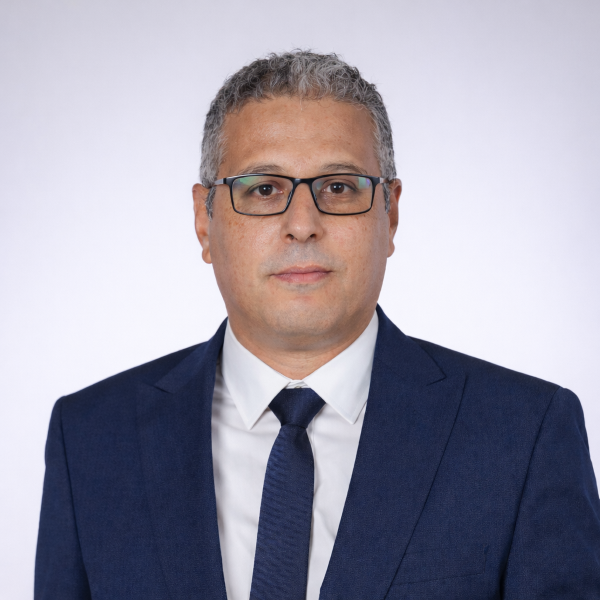
We previously spotlighted researchers Diana Flórez and Oricia Ngenyibungi. Today we’d like to give the floor to Belal Jahjooh, a Palestinian policy analyst living in Egypt. He coordinated the research and was the lead author of our recent report on the gendered impacts of food insecurity and famine in Gaza.
Here’s what Belal had to say:
I feel a very personal connection to WRC’s mission because, as a refugee myself, I understand what it means to lose your home, your belongings, and a sense of safety. I have lived through the uncertainty of displacement and the struggle to rebuild dignity and belonging in difficult circumstances. This lived experience shapes how I approach my work, reminding me that behind every statistic there are human lives and untold stories. WRC’s commitment to placing the voices of women and marginalized groups at the center of humanitarian response resonates deeply with me.
Professionally, I admire research and evidence-based advocacy work. WRC implements this approach in a remarkable way, combining rigorous analysis with a deeply human perspective. I value how evidence is not used in abstraction but instead directly connected to people’s realities, turning research into a tool for accountability and change.
The situation in Gaza is nothing short of a nightmare—a pool of injustices that a person can scarcely imagine, in which families are stripped of their homes, their safety, and their basic rights. For me, working on WRC’s Gaza report was not just another research assignment, but a moral duty to document and give voice to these injustices, to put a face to suffering that is too often reduced to numbers.
My work on gender equality did not begin in an office but as an activist confronting inequality and discrimination, determined to give people’s struggles visibility and voice. Over time, that activism evolved into a professional path, but the core motivation remains unchanged: to ensure that women’s experiences and leadership are central to how the humanitarian community understands and responds to Gaza.
What surprised me most while researching the report was discovering the resilience and creativity of Gazan women who, despite losing their homes and livelihoods, found ways to survive and showed a remarkable readiness to swiftly rebuild their futures. Many spoke of organizing small community support systems, sharing the little food they had, or rationing their own meals so their children could eat. At the same time, I was struck by how powerless the world appears when it comes to protecting its most vulnerable. While women were recounting how they rationed food or fled with nothing but their children in their arms, the international community remained locked in endless debates. The failure to uphold and implement international laws exposed a double standard that allows suffering to continue unchecked.
I used to believe that people like me, who work in emergency contexts as a career, learn over time to protect themselves and block some of the pain. But the situation in Gaza, and the stories I heard from the women there, broke whatever invisible shield I had accumulated. Salma’s story, in particular, made me weep. She is a mother and a nurse who was prevented from coming to the aid of her wounded child. She watched him bleed to death on the street, right before her eyes. Why should anyone have to experience this? Why could Salma not save her son?
I was also deeply moved by a young woman with a disability who, in the midst of bloodshed and devastation, was determined to continue her education and one day gain a good job. Hearing her speak about hope and ambition while surrounded by destruction was both heartbreaking and inspiring, a reminder of the extraordinary human spirit that survives even in the darkest conditions.
We must amplify the voices of impacted women and girls like these to the greatest extent possible, because their experiences and leadership are the compass for designing real solutions. Women and girls are not only the most affected by displacement and food insecurity; they are also central to resilience and recovery. Yet, too often their perspectives are pushed aside. In order to deliver lasting change, we must put women’s voices, dignity, and rights at the core of humanitarian and development advocacy.