
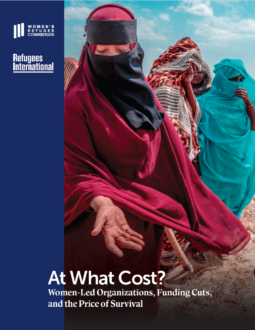
At What Cost? Women-Led Organizations, Funding Cuts, and the Price of Survival
PublishedAt a time when humanitarian needs are reaching record levels, the global humanitarian system is confronting a profound funding crisis. Beginning in late 2024 and intensifying throughout 2025, major donor governments, particularly the United States, significantly reduced humanitarian assistance, leaving humanitarian actors struggling to meet growing demands. Women-led organizations (WLOs), despite their essential role in reaching and supporting women and girls in crisis settings, have been disproportionately affected by these cuts.
The research in this report from Women’s Refugee Commission and Refugees International examines how WLOs in humanitarian settings are experiencing and responding to recent funding cuts. It explores the challenges they face, the strategies they are adopting to survive, and the implications of these adaptations for women and girls, humanitarian reform, and efforts to shift power and resources to local actors. The research draws on a literature review and 28 key informant interviews with WLO representatives in Afghanistan, Bangladesh (Cox’s Bazar), Honduras, Lebanon, Sudan, and Ukraine. Interviews were conducted in May 2026 and analyzed using a participatory, inductive approach to identify common themes across contexts.
The findings reveal that funding cuts are not only creating immediate operational challenges for WLOs, but are also exposing deeper structural challenges within the humanitarian system. WLOs described being pushed into increasingly unsustainable survival strategies that rely on personal sacrifice, unpaid labor, and organizational downsizing. While these adaptations may enable short-term continuity, they come at significant cost: reduced access to services for women and girls; erosion of hard-won gains in gender equality and women’s rights; loss of technical expertise and institutional memory; and weakening of community-based protection systems.
The report concludes that humanitarian reform efforts must go beyond managing scarcity and instead address longstanding imbalances in power, funding, and decision-making. Doing so will help ensure that humanitarian systems emerge from this funding crisis fairer, more sustainable, and more responsive to the communities they serve.