

The Women’s Refugee Commission is acutely concerned about the escalation of conflict and displacement across the Middle East region in the wake of the United States’ and Israel’s wars with Iran and Lebanon. Despite the announcement of ceasefire agreements to pause the fighting, civilians have continued to be caught in violence.
WRC is investigating how women and girls in the region are navigating this crisis and the unique harms they face. We reached out to trusted partners in the region, asking them to share their experiences with us so that we could in turn amplify their voices.
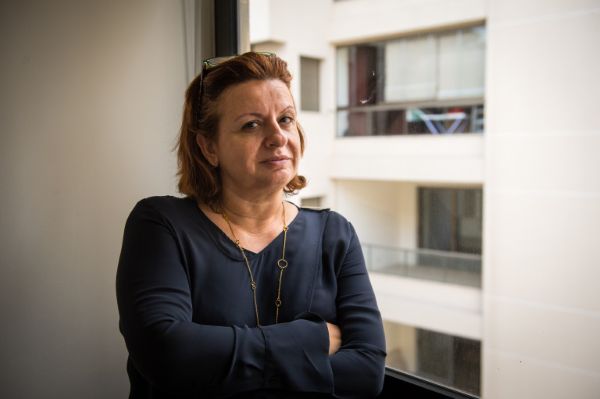
Today, we would like to share the testimony of one of those partners, Lina Abou Habib, a feminist leader and director of the Asfari Institute for Civil Society & Citizenship at the American University of Beirut, with whom we spoke by video call in late April.
Her words have been lightly edited for length and clarity.
The impact of the conflict on women and girls
In a country like Lebanon, which is really small but with many different demographics and geographies, the impact of the war is not felt in the same way by everyone. What is felt in the same way is the fact that things do not work. There are issues with mobility, with getting in and out of the country, work disruptions, etc.
An added complication right now is that even with the ceasefire, a large proportion of the displaced cannot return home, because we have gone back to a situation of not just complete occupation, but also omnicide—the burning of the land and its people. We didn’t have this after the war in 2024. In 2024, the violence stopped and people returned home and started repairing. There is absolutely nothing to repair right now. So that’s a major difference.
And speaking about the ceasefire, first of all, it’s not a cessation of violence, it’s just a temporary ceasefire, and it has never been adhered to 100 percent. So, it’s basically just less bombardment for a certain period of time.
Women carry unseen burdens that are not part of the diplomatic conversation
There are three papers that we’ve just finished on the ways in which women are carrying the burden of care during and after the conflicts [in Lebanon, Syria, and Gaza, respectively]. I mean, I have to qualify this—you cannot really talk of “after” the conflict. I would say during a period of lull in the conflict rather than post-conflict.
The papers show how, even though the three geographies are different, the shape of the conflicts are different, and their histories are slightly different, there are many similarities. One is the fact that women had to do everything, from fleeing, to making sure that there is food, to making sure that the children are safe, to taking care of health, to cooking for larger families, to feeling guilty because they need to do more and they are responsible for the lives and livelihoods around them. And they carried this guilt around at all times.
It’s important to see there are different stories for different women—women with disabilities, queer women, migrant workers. One of the most vulnerable categories of women, which is migrant women domestic workers, who have organized in the last decade or so, are actually at the forefront of feeding other displaced families and other women. It’s an amazing kind of dynamic that we are seeing and recording. That’s a really important point.
Another important point is that this is the first time that there is a recognition of sexual and reproductive health, in terms of how do we meet a health-related need. Menstruation has been recognized as a priority. Two months into the conflict, there are more than a million people who have had their periods twice during this time. What does it mean in shelters when there is no privacy? What does it mean when they actually don’t have pads? All the risks, all the discomfort and all the shame, that’s really another aspect.
The other thing which is worrying in the longer term is women’s loss of some economic independence. It’s not possible to go back to it, because this economic independence came from agricultural work that can no longer be done because the means of production have been destroyed completely. With the loss of economic independence comes also the loss of autonomy, as well as vulnerability. This has been a breeding ground for [those distributing aid] asking for sexual favors in return for “milk and mattresses” and so on.
It’s really a compounded loss and a compounded grief; things are not going to go back to the way they were, regardless of the fact that the way they were was not ideal to start with. This [war] comes at a time of years and years of an economic crisis that’s beyond a crisis; it’s an economic breakdown.
Lots of it boils down to two things: the ways in which the care burden is multiplied, and the ways in which vulnerability to violence, to exploitation, is also multiplied against a background of destroyed schools, destroyed hospitals, destroyed dispensaries. Yet this is not on the current negotiation table. None of this is part of any discussion, between Lebanon and Israel or between the United States and Iran.
The impact of years of war
I’ve lived through 15 years of civil war, and of course, I still have vivid recollections. After the civil war, the major incidents were 1996, 2006, 2024. It feels like there is a normalization of war here: It’s always been like this, and peace for us is a period between wars. There is even an app, if you’re Lebanese and you enter your date of birth, it will calculate how much of your life has been spent in a war or in conflict.
What we’re bearing witness to right now [is much more intense than in previous conflicts], in terms of the sound, in terms of the level of destruction, in terms of how many victims there are in a few minutes. It is a very clear message that nobody is safe. And just the sheer amount of what you see in these situations, it’s not something that you can easily get over or forget.
Women and women’s issues need to be part of the conversation
[Governments] can do as many National Action Plans for Women, Peace, and Security [NAPs] as they want. As long as governments continue to invest in militarization—because this is not just about militarized armies, this is also about militarized societies, and militarization has never been useful to anyone except the arms dealers—that conversation [around NAP] may be futile.
Some people in the movement are saying, “Well, let’s finish the occupation first and then we will deal with these folks [the women’s movement]. You know, when people who were colonized were going through their national struggles to kick out the colonizers, women were part of it. And women were told all the time, you know, “Let’s put your things aside and then when we have liberation, we’ll get to it.” Well, it’s been 100 years and they haven’t gotten to it. So I’m appalled at how resistant we are to learning from history, and then it has this tendency to repeat itself.
There are significant shifts that need to happen so that we can look towards the beginning of a just future. And the big questions are not being asked, like, for example, all the climate deterioration that is the result of phosphorus bombing, what will happen with this, and who’s responsible for the destruction? Generational loss of education amongst large communities of children. What will be done about this? And are we allowed to continue to count on women’s free labor and women’s guilt and women’s acquired gender roles to take care and clean and feed, at the expense of their own agency and their own well-being?
It was difficult enough to push these conversations in times of supposed peace. And, you know, nothing better than military violence to push this conversation to the side indefinitely.
It is regrettable that the overwhelming majority of people do not even see a discussion around the impact of conflict on the care burden as an issue. [They ask] why we are talking about this. Well, we’re talking about this because that’s what keeps you alive.
Note: For information about the Asfari Institute’s rapid scoping of civil society action during the 2024 Israeli war on Lebanon, visit this link.