
In the humanitarian community, September marks not only the end of summer; it’s also when international, multi-lateral diplomacy moves back into high gear. Every year, the United Nations General Assembly comes together for three weeks at UN Headquarters in New York to deliberate global policy and make key decisions that have broad implications for humanitarian practice. Then, during Women, Peace, and Security (WPS) Week at UN HQ in October, feminist leaders gather to advance women’s full participation in conflict prevent, resolution, peacebuilding, and recovery. In December, UNHCR will convene the High Commissioner’s Dialogue on Protection and Solutions, as we mark the 75th anniversary of the 1951 Refugee Convention.
Meanwhile, in the United States, the next Supreme Court term starts in October, with several cases on the docket that impact immigrants, women, and families. Furthermore, November’s midterms could have significant repercussions on the political field.
What does that mean for WRC? Our mandate is to bring the voices of refugee, displaced, and migrant women and girls to the halls of power, to advocate for their needs, and to center them in decision-making processes that fundamentally affect their lives. Here are a few ways that we will be leveraging our recent research and briefings—all of which are grounded in the testimonies of impacted women and their supporters—to advance our advocacy both internationally and domestically:
- In November, we will complete our inaugural Humanitarian Futures Fellows program, which supported six women with lived experiences of displacement to lead independent research projects exploring displacement, gender, and justice. Over the coming months, we’ll be bolstering our fellows as they lead advocacy efforts to influence change at local, national, or global levels.
- The priorities, experiences, and leadership of displaced women and girls must be centered in UNHCR’s global dialogues around the future of protection and solutions. In June, we hosted an online event featuring several WRC partners, exploring the future of protection for displaced women. To continue this work, WRC will convene a series of dialogues over the next two months, dedicated to exploring some of the more specific priorities and needs of displaced women and girls. We’ll distill concrete recommendations from these conversations to share with UNHCR ahead of the High Commissioner’s Dialogue in December.
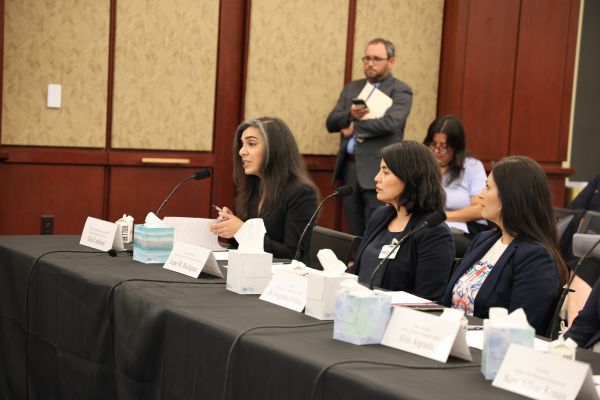
- Our Director of Migrant Rights and Justice, Zain Lakhani, testified before the Democratic Women’s Caucus at a hearing on how the second Trump administration’s immigration enforcement policies are harming women and families. Her testimony continued to drive vital education and policy solutions to the policy makers, to help create change for vulnerable populations.
- Our Migrant Rights and Justice team helped draft and support the introduction of two pieces of legislation, the HELP Separated Children Act and Orlin’s Law, which prevent family separation and help reunify parents and children. Both the legislation and continued efforts in Congress to protect family unity are informed by our one-of-a-kind evidence-based research in Central America, documenting how family separation is occurring and driving multilateral solutions—in the US, at the UN, and with receiving country governments themselves.
- The team also provided vital evidence, through both comments and invited high-level briefings, to the UN Special Rapporteur on the Human Rights of Migrants, for their forthcoming report on Children’s Right to Family Life in the Context of Migration and Asylum Policies. The report, expected in October, will set international human rights standards on the right to family unity for the coming decade, including defining key goals and benchmarks for Member States.
As conversations unfold across the US and UN, WRC remains committed to ensuring that the perspectives of displaced, refugee, and migrant women and girls inform the decisions being made. Our research and advocacy work are intended to translate lived experience into concrete policy outcomes, whether through the recommendations we bring to the High Commissioner’s Dialogue, our continued support for family unity legislations, or advocacy efforts led by our Humanitarian Futures Fellows. We look forward to sharing more as this work progresses.