
“What transformed my life was not charity. It was inclusion. It was being given the opportunity to participate, to contribute, and to lead.”
– Laura Valencia, Coordinator and Leader, Global Refugee Youth Network
For 36 years, the most central, enduring, and indelible aspect of our mission at Women’s Refugee Commission has been that we listen to refugee women. We center their voices and partnership in our research, and we promote their solutions in our advocacy. We do this because they are on the frontlines, having experienced displacement and statelessness firsthand, but also because they find ways forward even when institutions have failed them.
Sometimes, our role at WRC is simply to make sure that women refugees are at the table when research is being done and decisions are being made, and that they are given their rightful opportunity to lead. This leads to better, longer-lasting solutions not only for refugees but also for entire societies.
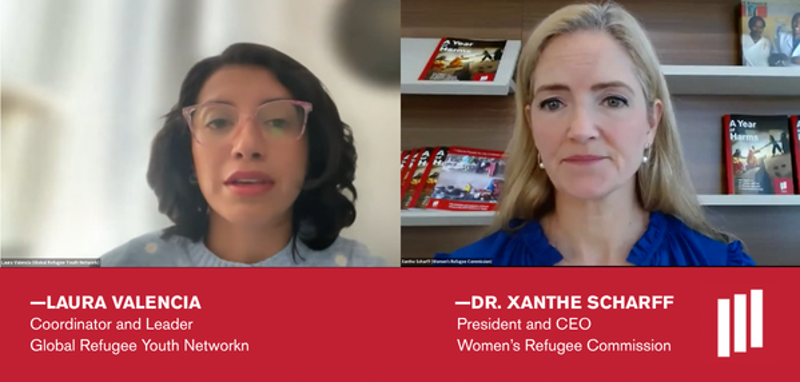
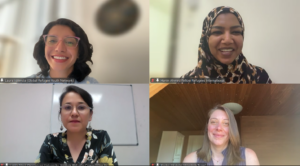
On June 25, it was my honor to moderate a conversation with four refugee women who are charting the way forward. As the newly appointed CEO of WRC, this was exactly how I wanted to start my leadership: by listening. Our webinar, which was attended by almost 100 people around the globe, kicked off a series of public and private consultations with refugee women, policymakers, and donors that we will host through 2026 to mark the 75-year anniversary of the 1951 Refugee Convention.
Watch here:
Ruvendrini Menikdiwela, UNHCR’s Assistant High Commissioner for Protection, honored us with opening remarks that underscored the severity of funding cuts as well as the continued importance of the Refugee Convention as a global framework for the protection of displaced people. She set the stage for our speakers to emphasize the ways in which protection for refugees needs to evolve, including the following:
Discriminatory citizenship laws create extreme vulnerability for refugee women and children.
Rasha Altabshi, a partner of the WRC-hosted Global Campaign for Equal Nationality Rights, spoke about the challenges that she and other Syrian women have faced securing paperwork for their legal status—made more difficult now because some countries no longer offer asylum or protection for Syrian refugees. Though the war is over, Syrian women still face the prospect of physical and economic insecurity upon return. Furthermore, because Syrian women cannot pass their citizenship to their children under Syrian law, families have been separated as returning mothers have been forced to leave their children behind. Meanwhile, the foreign-born children who are able to enter Syria are at risk of discrimination.
Later in the same day as our webinar, the US Supreme Court ruled to allow the Trump administration to end Temporary Protected Status (TPS) for Syrians and Haitians. WRC subsequently released a statement featuring Rasha’s advocacy.
Refugee women leaders draw on powerful experiences to inform their agenda for change.
Latifa Alavi is a WRC Humanitarian Futures Fellow and a lecturer at the University of Strasbourg. After having been displaced in Iran for many years, she returned to her home country of Afghanistan to work with women in prisons as a social worker. This experience informs her research today, which focuses on women forced to return to Afghanistan who struggle to access maternal health care.
Young refugee women are experts in their experiences, and they must be included in designing solutions.
Laura Valencia, Strategy and Partnerships Coordinator at the Global Refugee Youth Network, which is hosted by WRC, spoke powerfully about her experience of displacement from Colombia to Ecuador. Due to lack of documentation, her school enrollment was delayed and she spent many years waiting for asylum. Laura’s quote headlines this email, and she also said:
“Displacement does not define a person’s potential. What often makes a difference is whether systems recognize refugees, especially refugee women, not only as people in need of protection, but as leaders, experts, and partners in creating solutions.”
Getting resources directly to the frontlines is essential.
Hanin Ahmed is the External Relations Officer for Sudan’s Emergency Response Rooms and the author of WRC’s forthcoming policy brief on how women-led organizations protect women and girls in Sudan. She spoke passionately about the ways that Sudanese women have been abandoned by the international system—and she shined a light on her work implementing innovative approaches to getting direct cash assistance to Sudanese women so they can take back control of their lives, even while displaced.
We are in uncharted territory when it comes to refugee response systems. We still need multilateral conventions and commitments to protect women, even while recognizing that implementation has always been flawed. As we mark 75 years of the Refugee Convention, we need to be clear-eyed about the way forward—and that is to listen to the women who have lived experience of displacement, to facilitate their research and leadership, and to fund the organizations that they lead.
I look forward to learning more from WRC’s network of refugee women researchers, advocates, and leaders around the world, and to sharing more with this community.
We want to hear from you, too. As we mark the 75th anniversary of the Refugee Convention, what conversations should we be hosting?
Thank you for your support—and for listening with us.
Xanthe Scharff, President and CEO
_______________________________________________________________________
More news from WRC following Supreme Court rulings
On July 1, we hosted a Press & Policy briefing with our Director of Migrant Rights and Justice, Zain Lakhani, in which she outlined how three recent Supreme Court decisions—on TPS, turning back asylum seekers at the Southern border, and birthright citizenship—will impact refugee and migrant women and families. Watch the recording here.
Read Zain’s commentary in Mother Jones, Public News Service, and Big News Network about how these issues play out in states like Florida, Illinois, and Pennsylvania.