

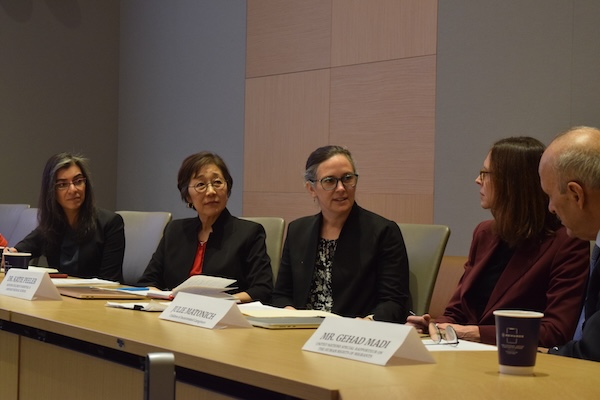
October was a vital month for migrant and displaced women and families at the United Nations. In addition to WRC’s robust participation advancing displaced women’s rights at Women, Peace, and Security week, I was honored to join the Special Rapporteur for the Human Rights of Migrants, Gehad Madi, at an event launching his landmark report on Children’s Right to Family Life and Family Unity in the Context of Migration and Asylum Policies.
The report sets the global agenda for preventing and responding to family separation. Special Rapporteur Madi’s bold and practical recommendations reflect many of WRC’s core values around protecting family unity and advancing a world where migrant family life is protected. And in setting these vital goals, the report draws heavily on WRC’s research on family separation in Mexico and Central America; reflected in our own unique evidence-based reporting as well as in our submission and consultations with the Special Rapporteur’s office.
Our side event, co-sponsored with the University of Minnesota Law School’s Human Rights Clinic and Children of Incarcerated Caregivers, provided an opportunity for robust discussion with Special Rapporteur Madi—not only about this report, but also about his upcoming work on immigration detention. Alongside experts in healthcare, law, and policy, we discussed the challenges of protecting the rights of pregnant people, children, and families in the context of immigration enforcement. In my remarks, I addressed the need for robust data and evidence collection to ensure protections for both pregnant women and separated families. I made a point to share the words of impacted parents whom WRC interviewed in Honduras alongside Physicians for Human Rights, so that the Special Rapporteur could get first-hand testimony revealing the harms to children and families caused by the administration’s approach to immigration enforcement.
In addition to presenting findings from this report, Special Rapporteur Madi also shared upcoming priorities for his mandate, including addressing the increased prevalence and decreased standards of immigration detention, globally and in the US. WRC will continue to support these efforts to set critical benchmarks for the rights of immigrant and displaced people at home and around the world.
I came away with a renewed sense of the vital role that WRC and peer organizations play in leveraging research and advocacy for policy change at the highest levels. I hope you will be similarly buoyed knowing that the voices of parents impacted by family separation are being heard by the Special Rapporteur. We look forward to continuing our collaboration with him to advance migrant rights and protection.
ICYMI: Zain recently spoke with The Persistent for a fantastic Q&A about her work to improve oversight of the immigration enforcement system, ensure accountability, and enact policy change to protect women and families. Read it here.