
In 1951, the UN Charter cemented gender equality as a core pillar of the organization’s mandate and mission, declaring, “We the peoples of the United Nations determined … to reaffirm faith in the equal rights of men and women.” For more than 70 years, that declaration served as a guiding principle, yet a series of external crises and internal reform efforts over recent years have endangered the future of the UN as a global driver of gender equality. Member States must act decisively to course-correct and ensure the UN retains its leadership in this critical area.
Over the past eight decades, feminist civil society groups around the world have worked tirelessly to enact the UN Charter’s commitment to gender equality across the institution, including by establishing the Commission on the Status of Women (1946); adopting the Convention on the Elimination of All Forms of Discrimination Against Women (1979), the Beijing Declaration and Platform for Action (1995), and UN Security Council Resolution 1325 on Women, Peace and Security (2000); including goals for gender equality under the Millennium Development Goals (2000) and the Sustainable Development Goals (2015); and establishing UN Women in 2010.
This infrastructure has translated into real and meaningful progress on gender equality—for example, through concrete legal reforms to end gender discrimination and criminalize gender-based violence; progress towards achieving gender parity in education; and an increase in women’s political representation and leadership at national and international levels. Critically, global norms have measurably shifted over time: Gender equality has been increasingly recognized as instrumental to creating peaceful, just, and prosperous societies. While progress has been painfully slow, insufficient, and uneven, the advances made have nonetheless been consequential and transformative—and only possible due to sustained pressure and coordination between civil society, Member States, and UN staff to embed and advance gender equality as a priority across the UN.
Yet 2026 finds these systems at risk of unravelling. Gender equality functions across the UN are facing pressures from multiple angles. Stalemates at the UN Security Council and failures to uphold key elements of the women, peace, and security agenda are coinciding with escalating and intensifying conflicts in places such as Gaza, Sudan, and Lebanon, where international humanitarian laws are being repeatedly violated and women and girls are facing disproportionate risks and harms. A liquidity crisis, the result of countries failing to fulfill their dues to the UN—and accelerated by abrupt and massive US foreign assistance cuts to UN agencies—have led to cuts and restrictions across multiple UN functions impacting refugee women and girls. These include cuts to food rations by the World Food Programme, the closure of safe spaces for survivors of gender-based violence by the UN Refugee Agency, and a 25 percent cut to UN peacekeeping forces across nine crises—all of which will deepen inequalities and increase harms for women and girls, reversing years of progress.
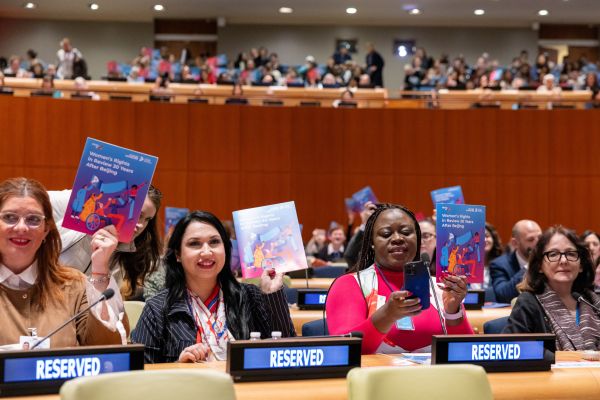
Meanwhile, mounting political and social backlash has led to gender equality stagnating or regressing in 40 percent of countries. Against this backdrop, the Trump administration’s withdrawal from UN Women and UNFPA, along with the administration’s de-funding of key gender equality, women’s rights, and reproductive health activities across the UN, has further tightened the capacity of UN agencies to advance gender equality in fragile or hostile environments. Moreover, US travel restrictions, funding cuts, and wars have led to a noticeable decline in global feminist civil society presence at key UN convenings, such as the Commission on the Status of Women (CSW) in New York this year. The absence of key stakeholders restricted the capacity of feminist civil society groups to coordinate and drive forward change amidst challenging circumstances. All this was further compounded by the US efforts to derail the Commission’s political declaration committing to progress on gender equality.
Amidst this turbulence, the UN is navigating two key processes: the UN80 reform initiative and the selection of the tenth UN Secretary General. Both these processes have massive implications for gender equality; their outcomes could either cement the UN’s shrinking capacity on gender equality or revitalize political energy in support of human rights, equality, and peaceful multilateral cooperation.
Reform or regression?
When UN Secretary General Antonio Guterres launched the UN80 reform process in March 2025, he claimed that reform would create “efficiencies” that would produce a “stronger and more effective United Nations that delivers for people.” Yet more than one year into the UN80 reform process, both civil society and Member States have raised the alarm that some of its key proposals will undermine the UN’s capacity to deliver on gender equality.
Notably, civil society groups have warned that a proposal to merge UN Women and UNFPA may erode gender equality and reproductive health mandates and capacity within the UN, dismantle specialized infrastructure and programming, and shrink the normative space for gender equality within the UN. Recent analysis shows that not only would this merger fail to offer any meaningful efficiencies or cost-effectiveness for the UN, but it would actually risk shrinking donor contributions for UN Women and UNFPA’s distinct areas of work. This would put protection and services for women all over the world at risk, at a time when women’s rights and gender equality are already under siege. Civil society and feminist governments have also highlighted their exclusion from decision-making, and the lack of evidence or transparency related to the merger, despite their historic leadership in creating the UN’s gender equality work.
Member States must demand feminist leadership
Concurrent with the UN80 reform process, the UN is electing a new Secretary General (SG) later this year. At this pivotal moment, the selection could prove existential to the UN and its ability to advance gender equality. At a time of growing global inequality, increasing militarism, and entrenched cultures of impunity for those who violate international law and human rights—and after a succession of nine male SG’s—egalitarian leadership at the UN is not a luxury, but rather an urgent necessity. Many have rightly called for the next SG to be a woman; it is also essential that they be a feminist. We cannot risk choosing an SG who oversees the decline of the UN by succumbing to Member States’ pressures to quietly diminish gender equality language, programs, funding, and mandates across the organization.
Member States have the opportunity to insist on a democratic selection process as an alternative to the hegemonic control of the UN Security Council. They can and should demand a leader who will be courageous and unapologetic in advancing human rights, gender equality, and protections for refugees; who will challenge systems of injustice, oppression, and exclusion; who can recognize the flaws of multilateral systems; and who can offer a vision for something that works better—not for those in power, but for those whom the UN is supposed to protect: the people.
Billions of women and girls depend on the UN’s leadership. We cannot afford to backslide.
At a UN Security Council debate this week, the current SG, Antonio Guterres, said, “The UN Charter is a survival guide for humanity.” For this to remain true, the UN cannot afford to shrink its voice, mandates, or investments on gender equality. To do so would be an abandonment of the UN’s founding mission to reaffirm the equal dignity and worth, and to advance the equal rights, of every human. The UN is uniquely positioned to lead on gender equality—it sets international human rights standards, commands convening power at the global level, and operates dedicated entities like UN Women and UNFPA, which hold both normative power and operational systems to protect and advance gender equality from the grassroots to the global stage. A centralized global body led by a strong feminist is required to push back against any reversals on gender equality and keep women’s rights at the center of international cooperation.
Member States must also push back on harmful UN80 proposals, which risk undermining the UN’s gender equality leadership. They must insist on the meaningful inclusion and leadership of feminist civil society across UN reform processes. They must ensure the selection of an SG who upholds and advances feminist principles of justice and accountability.
This is not a wish list, but rather a vision. When Member States take firm, decisive, and coordinated action—as they did during CSW—they can drive powerful change. Member States must be courageous in their vision for the future of the UN, and they must insist upon upholding the promise of gender equality that generations of activists—from civil society, across national governments, and within the UN itself—have fought for.