
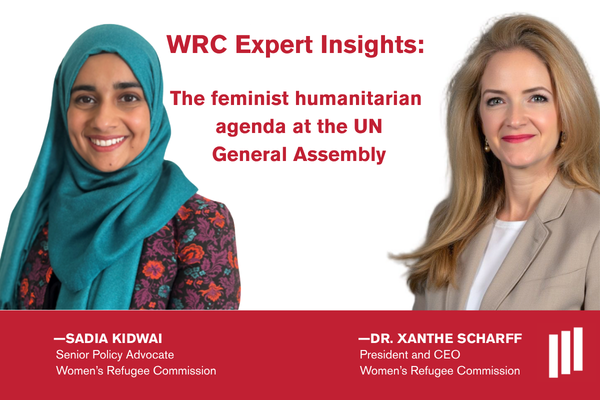
With the UN General Assembly underway and High Level week starting this Friday, WRC’s CEO, Xanthe Scharff, sat down with our senior policy advocate, Sadia Kidwai, to get a sense of the stakes for humanitarian and gender equality issues.
Here’s an excerpt of their conversation. It has been lightly edited for length and clarity:
Xanthe Scharff: What are the most important issues at UN General Assembly this year for gender, women, and refugees?
Sadia Kidwai: It’s really hard to talk about that without taking a step back and understanding the bigger picture of what’s happening at the UN right now. The first thing we need to talk about is UN80. The UN Secretary-General launched this process in March 2025 to mark the 80th anniversary of the UN. It was presented as an opportunity to reform the United Nations. After 80 years, the UN has expanded drastically into many organizations, mandates, and bodies. Given the financial crisis that the UN is in right now, and the political crisis of legitimacy and multilateralism, the Secretary-General wanted to reevaluate the UN system to see how we could make it more streamlined, efficient, and effective.
One key piece that feminist civil society is paying attention to is the proposal to merge UNFPA with UN Women. UNFPA is the UN’s sexual and reproductive health agency, and UN Women is the lead agency on gender equality within the UN.The proposal for the merger was presented as an opportunity to create efficiencies.
I think what’s notable is that, of all the UN agencies out there, it was UNFPA and UN Women that were particularly singled out first for a merger proposal. These are not the biggest agencies within the UN system. This is not where you’ll find the biggest cost savings. Yet it was the two agencies that disproportionately impact women’s and girls’ lives that were chosen for a merger.
Xanthe: What are the dangers of this merger and what advocacy are you doing with others to protect the best possible scenario for gender equity?
Sadia: There’s a real political risk that governments that want to roll back gender equality and undermine the UN’s gender equality systems will use this as an opportunity to diminish the mandates of both UN Women and UNFPA. There is also a financial risk. At the moment, a government might provide a certain donation to UN Women and another contribution to UNFPA. If merged, it may undermine the long-term financial viability of these organizations.
There are also risks to technical expertise. UN Women and UNFPA are really different agencies. There is some overlap around gender-based violence, but fundamentally they have quite different mandates.
This is really not the moment to take risks with two of the strongest agencies for women’s protection and women’s rights in the UN system. What we need to be doing is doubling down on protecting them.
Xanthe: Well said. So, what are we and others doing to try to push back?
Sadia: Feminist civil society groups have come together really strongly to scrutinize these proposals.
The strong message from civil society, which WRC has joined, is that we oppose the UNFPA and UN Women merger because of the risks involved. More than 1,400 feminist and civil society organizations signed an open letter outlining those concerns.
Xanthe: There’s another massive movement underway at the UN with the appointment of the next Secretary-General. How is that process interacting with civil society concerns and advocacy for gender rights?
Sadia: Alongside these UN80 reforms, [Member States] are also being asked to select the 10th Secretary-General of the United Nations.
This comes at a really pivotal and consequential moment for the UN. We can’t talk about gender equality and women’s rights without understanding how they fit into the broader context of what the UN stands for.
We have had nine male Secretaries-General in succession over the UN’s history. Many civil society groups and governments are saying the time is now for us to have a woman Secretary-General.
Many organizations, including WRC, would go beyond that and say that what we really need is a feminist Secretary-General.
Thanks to civil society advocacy, the process has become much more transparent. Candidates put out vision statements, declare conflicts of interest, and engage in town halls and dialogues with civil society and governments.
WRC put a question directly to a candidate about their commitment to women’s rights, gender equality, and the protection of refugees and displaced people.
We don’t expect major decisions at UNGA, but we will see a lot of conversation around the candidates.
Xanthe: What happened last year as far as pushback from civil society or governments in defending gender equality as a value?
Sadia: Over the past year and a half, we’ve seen the US try to assert its power and influence within different UN systems to roll back language, protections, and consensus on gender equality, women’s rights, and particularly sexual and reproductive health and rights.
One example is the Commission on the Status of Women, the UN’s annual conference on gender equality and women’s rights. Every year, the Commission releases a political declaration that sets the agenda for the UN’s priorities on gender equality for the coming year. For decades, governments have been able to adopt that declaration by consensus.
This year, the US attempted to derail that process, submitting dozens of amendments trying to pull back and deconstruct language around gender and sexual and reproductive health and rights. What we saw in response was almost all members of the Commission coming together to push back to effectively isolate the US. Ultimately, the declaration could not be adopted by consensus because the US forced it to a vote. In that vote, the US was the only government that opposed the political declaration.
Xanthe: What will you be doing to leverage WRC’s research for positive change when you are at UN General Assembly this year?
Sadia: Over the last 18 months especially, we’ve been doing an incredible amount of research investigating the impact of funding cuts on humanitarian responses and the protection and safety of women and girls in humanitarian settings.
We have this huge body of evidence that tells us what it looks like when we deprioritize investments in women-led organizations, sexual and reproductive health and rights, and gender-based violence prevention and response services.
That evidence drives all of our advocacy. When we’re talking about opposing the UNFPA and UN Women merger, we’re saying that based on our evidence and our documentation, when you deprioritize gender equality programming, women and girls directly suffer as a result. They have less access to safe spaces. They are more at risk of violence, exploitation, and abuse. We’ve documented cases of women dying in pregnancy or labor because they weren’t able to access health care services.
This year also marks the 75th anniversary of the 1951 Refugee Convention. WRC really sits at the intersection of women’s rights and refugee rights, and we’re seeing a situation now where both are being attacked by people who want to break down asylum systems and exclude women from power, influence, and accessing their full rights.
We have to use this anniversary as an opportunity to rebuild consensus and strengthen political commitment to refugee protection, refugee rights, and the right to asylum, especially at a moment when displacement and conflict levels are almost unprecedented in history.
We would love to be in a position where we’re simply celebrating what has been achieved over the last 75 years. But this is a moment of real political urgency.
This dialogue was recorded for the podcast WRC Live and edited for length and clarity. We’ll be sharing the full episode on Spotify, YouTube, and social media next week.