

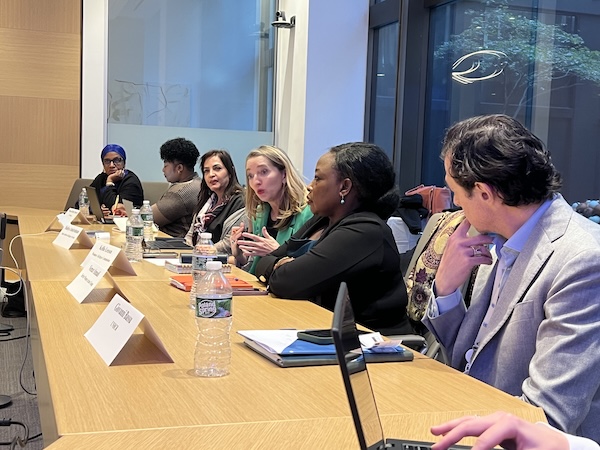
I’m writing to you from the UN Secretariat in New York, where Women, Peace, and Security (WPS) week is winding down.
Every year during the UN Security Council’s open debate on WPS, Member States deliver diplomatic statements in which they share progress, acknowledge challenges, and lay out priorities for delivering the four pillars of the WPS agenda: prevention of conflict and violence, protection of women and girls, participation of women in peace and security processes, and relief and recovery efforts that meet the specific needs of women and girls. Elsewhere within the UN Secretariat and in venues nearby, UN agencies, donor governments, and civil society groups host their own conversations and calls to action to advance WPS.
Last year—the 25th anniversary of the WPS agenda—WRC joined many other organizations in issuing a stark warning that WPS was on fragile ground. In the year since, the situation has in many respects worsened. Global conflicts and military spending are at record levels, the number of women and girls living in or near conflict has grown, cases of conflict-related sexual violence have more than doubled, and only five percent of peace processes included the meaningful participation of women negotiators—a decline from previous years. This year, due to nearly two years of funding cuts and targeted travel restrictions put in place by the US government, many women peacebuilders and human rights defenders—ironically—were not able to participate in WPS week in New York.
Despite these setbacks, WRC ensured that refugee and displaced women were heard.
Two years ago, I attended WPS week as WRC’s senior policy advisor and noted how underrepresented the specific needs, constraints, and experiences of refugee women were in conversations about WPS, despite the fact that refugee women are often the most impacted by violence. This year, we worked with partners—including UNHCR and UN Women—to bridge that gap, by co-hosting a panel event of women leaders who either have lived experience of displacement or who work at local or national levels to support refugee women.
Panelists talked powerfully about how refugee and asylum systems can work better with mechanisms that strengthen the protection of refugee women, support their leadership, and allow their safe participation in humanitarian response, peacebuilding, and human rights defense work. One panelist shared that refugee women-led organizations receive less than one percent of humanitarian funding and operate under risk of detention, deportation, and retaliation from host country authorities, despite taking on a high volume of cases referred to their organizations by international agencies. Niemat Ahmadi, from the Darfur Women Action Group, invited the audience to consider how many women human rights defenders, civil society leaders, lawyers, and organizers remain confined in refugee camps, unable to travel, formally organize, or access the resources they need to advance peace and security for their countries.
While WPS week is a critical forum, WRC’s advocacy on WPS extends far beyond the hallways of the UN. Earlier this month, WRC participated in the Sexual Violence Research Initiative (SVRI) forum in Bangkok, where Kellie Leeson (VP of Programs and Partnership) and Julianne Deitch (Director of Research), along with WRC research partner Rumana Akter, shared findings and recommendations from our latest report on the impact of funding cuts on safe spaces for displaced women and girls in Cox’s Bazar, Bangladesh. Also this month, WRC participated in the annual partners meeting for the Call to Action on Protection from Gender-Based Violence (GBV) in Emergencies, hosted by the global lead, the Norwegian Ministry of Foreign Affairs.
WRC knows that the best advocates for displaced women are displaced women themselves. This month, we were excited to launch our new series, Feminist Solutions in Displacement, which offers a platform for women with lived experiences of displacement to discuss critical policy priorities. Hanin Ahmed, co-founder of the Old Omdurman Emergency Response Room in Sudan, wrote the first policy brief in the series, exploring how women-led organizations, mutual aid groups, and Emergency Response Rooms provide protection for Sudanese women and girls.
Hanin’s message echoes what I have seen and heard repeatedly at WPS week: Women are not waiting for permission. Despite funding cuts or legal restrictions, women are continuing to organize, respond, protect, and lead. But this work is increasingly unsafe and unsustainable, and it often comes at great personal cost. If we want to curb the trends of record-breaking displacement, conflict, and gender-based violence, donors and states must invest in sustained funding, political protection, and full access to rights for women and girls. International organizations must continue to challenge unjust dynamics in humanitarian and peacebuilding spaces, shifting power and funding and amplifying the expertise and priorities of displaced women leaders.
As Hanin reminds us in her brief, “The women of Sudan have done everything that can be asked of anyone. The only question left is whether the world will do its part.”