
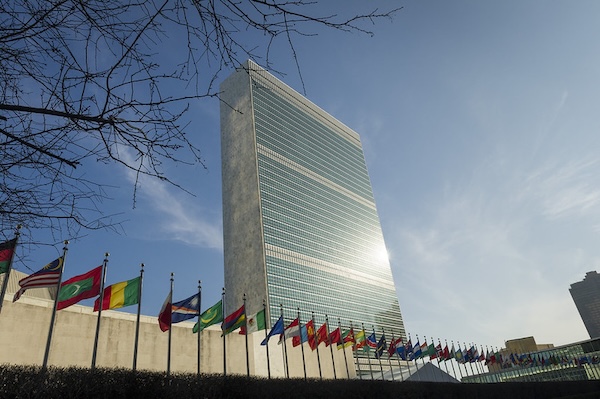
At the opening of the 81st session of the UN General Assembly (UNGA81), UN Secretary General Antonio Guterres framed the complex crises facing the world today as “the story of power: who has it; who is denied it; how it is used; and how it is changing.”
The story of the UN, in many ways, has also been a story of power, and how power is shared, shifted, or challenged between people, societies, and states. For more than 80 years, the UN has played an essential role in upholding and advancing human rights, gender equality, and peace and security.
Yet recent years have exposed the limits of the UN’s power—and the structural inequalities in its systems. In 2026, the world is experiencing the highest number of conflicts since World War II. More than 117 million people have been forcibly displaced by conflict and crisis, an almost historic level of displacement. Cases of conflict-related sexual violence have more than doubled between 2024 and 2025. Progress on gender equality has either stalled or regressed in 40 percent of countries. Powerful states—including those with permanent seats on the UN Security Council—have either directly engaged in or enabled war crimes and human rights violations, or failed to prevent those who do. Meanwhile, the weeks before UNGA81 saw dire warnings about the catastrophic humanitarian impacts of this year’s El Niño and alarm bells raised about the destructive capacities of artificial intelligence. The global order that the UN was founded to uphold appears to be deeply unstable.
The future of the UN
Amidst all this, the UN is undergoing significant internal changes, including a liquidity crisis, UN80 reforms, and the selection of the 10th UN Secretary-General. All of these will have an outsized impact on the future of the UN. As Member States increasingly withhold their dues or reduce their voluntary contributions, the entire UN system has contracted, including humanitarian and development programming, human rights monitoring, peacekeeping forces, and staffing. UN80 reforms, which have been shaped partly in reaction to the liquidity crisis, may result in the merger of UN Women and UNFPA, two agencies that play a critical role in gender equality and women’s health. At this critical juncture, the next Secretary-General—whom many hope will be a woman, for the first time in history—will shape the UN’s trajectory in world-changing ways.
It is no surprise, then, that the conversations at UNGA81 felt existential. Numerous panel events grappled with questions about the future of multilateralism and priorities for the next Secretary-General. Diplomats, civil society leaders, and policy experts highlighted the urgency of restoring the UN’s leadership in peace and security—starting with bringing a peaceful resolution to the devastating war in Sudan. Others stressed the need to move beyond the bureaucratic thinking of reform and instead provide a clear vision for how to radically adapt the UN to a changing world. Candidates in the race for UN Secretary-General appeared at events to offer their own visions for restoring political trust and engagement in the UN—yet as the latest straw polling reveals, the UN Security Council continues to be divided over the candidates, the future of the UN’s leadership remains murky.
Despite global uncertainties, voices of optimism and movements of hope at UNGA81 were unbowed. The Global Alliance for Human Rights, a multistakeholder movement launched by the UN’s Human Rights Office in June this year, convened a high-level event, which WRC attended, to strengthen commitments to upholding dignity, equality, and justice. WRC also joined states, philanthropists, and civil society leaders at an event on the sidelines of UNGA81 to prepare for the Copenhagen Summit for Gender Equality and Women and Girls’ Rights. Across multiple events, the message was clear: we cannot let go of our ambitions for a fairer world.
Upholding rights and strengthening protection for displaced women and girls
Throughout our engagement at UNGA81, WRC remained committed to our own ambitions to create a better world for refugee, migrant, and stateless women and children.
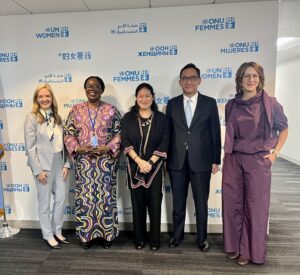
At an event led by the Global Campaign for Equal Nationality Rights in partnership with UN Women, Equality Now, and the Inter-Parliamentary Union, WRC Director Catherine Harrington brought together global leaders to revitalize ambitious action and global leadership towards equality in law for women and girls by 2030, with a call to action offered by WRC’s CEO Xanthe Scharff. Ann Syauta from the UN’s Human Rights Office shared a powerful message: “Equality for women and girls before the law and in practice is not optional. … It is a fundamental human rights principle.”
In partnership with the Civil Society Coalition for the 75th Anniversary of the Refugee Convention, WRC’s Vice President Programs and Partnerships, Kellie Leeson, facilitated a panel discussion between refugee leaders, humanitarian responders, and UNHCR representatives on how to strengthen adherence to the 1951Refugee Convention.
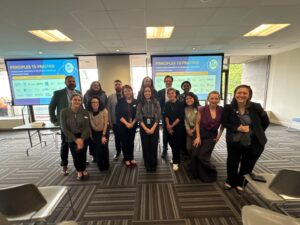
Working with the Refugee Self-Reliance Initiative, Innovations for Poverty Action, and Refugees International, WRC also convened a private, action-oriented roundtable with humanitarian actors, donor governments, researchers, and refugee leaders to discuss the opportunities offered by UNHCR’s new “50 by ‘35” initiative. The initiative seeks to reduce by 50 percent the number of refugees in protracted displacement who are dependent on humanitarian aid by 2035, in order to ensure meaningful self-reliance and dignified solutions for all refugees.
It’s time to rewrite the story of power.
Global systems of power are too often stacked against displaced women and girls, who face multiple layers of exclusion, violence, and human rights violations based on their gender and displacement status. A new WRC paper highlights how these power imbalances are reflected even in data around displacement—from data collection that asks male representatives to respond on behalf of women, to non-displaced policy makers collecting data to address their own priorities, rather than to answer the requests of displaced women and girls. As project lead, Christelle Cazabat notes:
“Data can do more than paint the picture of women and girls’ lives in displacement: produced in a participatory way, designed for them and by them, it can strengthen their capacities and reinforce their rights, elevate their voice, and sustain their agency.”
Despite power imbalances, displaced women and girls are often first responders in their communities, providing essential services and protections in places where global humanitarian systems, including even the UN, cannot reach.
WRC is committed to working with our partners, including displaced women, to rewrite the story of power—and to ensure that the next chapter of the UN’s story moves us closer to a world where rights are upheld, power is shared, and women and girls can live in safety and dignity wherever they are.