
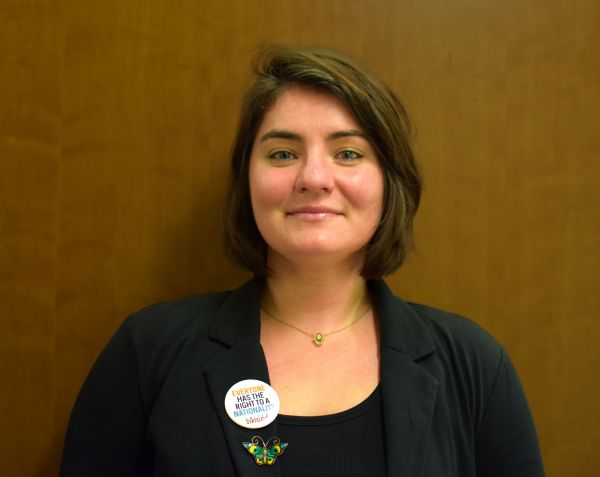
Karina Ambartsoumian-Clough is the Executive Director of United Stateless, a longstanding partner of the Global Campaign for Equal Nationality Rights, housed at WRC. She is also a 2020 WRC Voices of Courage Award recipient. In commemoration of the 75th anniversary of the 1951 Refugee Convention in July and 65th anniversary of the 1961 Convention on the Reduction of Statelessness in August, we invited her to share her reflections on the conventions’ impact on her life and experiences.
As the world marks the 75th anniversary of the 1951 Refugee Convention, we are reminded of the importance of protecting people forced to flee persecution, conflict, and violence. The Convention remains one of the most important international commitments to the rights and dignity of displaced people. This year also marks another milestone that receives far less attention: the 65th anniversary of the 1961 Convention on the Reduction of Statelessness.
I know this because I am stateless.
I was born in the Soviet Union and arrived in the United States as a child. While my family fled civil unrest and oppression and sought protection here, my lived experience has been defined not by refugee status but by statelessness. That’s because Ukraine, the country that replaced the Soviet Union in the area where I was born, does not recognize my Soviet birth certificate, and the US does not have a legal framework to recognize and protect stateless people like me. Thus, for nearly three decades, I lived in the only country I truly knew, without a nationality, a passport, or the certainty that I belonged anywhere on paper.
Refugees and stateless people are not the same. Many refugees have a nationality but cannot safely return home. Many stateless people have never crossed a border at all. Yet both experiences reveal what happens when people are denied protection, security, and belonging.
Too often, statelessness is left out of conversations about displacement. The result is that millions of people around the world remain invisible, unable to access basic rights, obtain identity documents, travel, work, or fully participate in society.
My experience is also what led me to help found United Stateless, a stateless-led organization dedicated exclusively to addressing statelessness in the US. Through legal services, community support, mental health programming, and policy and legislative advocacy, we work to ensure that people impacted by statelessness are no longer invisible.
Today, our community includes both immigrants who arrived in the US without a nationality and Americans whose births were never registered or whose citizenship has never been recognized. While their stories are different, they share a common reality: life without the protection and certainty that nationality provides.
As we celebrate the protections established by the Refugee Convention and the 1961 Reduction of Statelessness Convention, we should also remember those who continue to fall through the cracks of our international systems. The anniversaries of both conventions offer an opportunity to reaffirm a simple principle: Every person deserves a nationality, legal recognition, and a place where they belong.
Protection should not depend on whether the world recognizes your “category.”
As the world commemorates 75 years of refugee protection and 65 years of efforts to reduce statelessness, we should remember that behind every convention is a simple idea: No person should be left without protection, and no person should be left without belonging.
United Stateless and WRC joined other partners in filing two amicus briefs, one to the Fourth Circuit and one to the Supreme Court, identifying the crisis of statelessness that would occur should the courts have overturned birthright citizenship.