
In Her Own Words
“In Her Own Words” shares the stories of women living in the world’s most extreme conflict zones. The series brings into focus how women and girls bear the real costs of war and displacement. For more than 35 years, WRC has listened to women living through conflict and displacement and advocated for their rights and safety. Join us. #inherownwords
Click on any tile to read more.
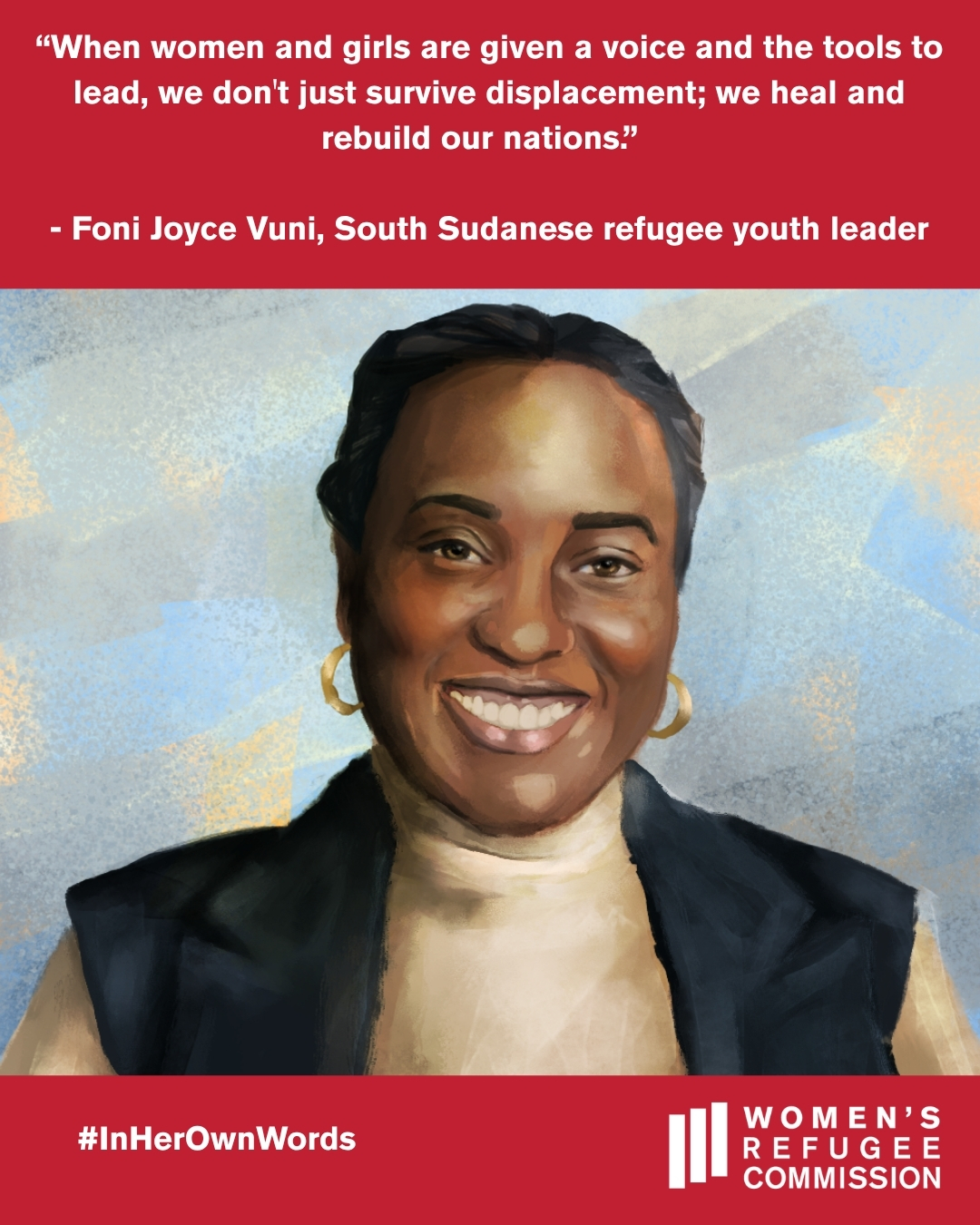
Foni Joyce Vuni
South Sudan
“Leaving your home and abandoning what you worked hard to build is not something anyone does voluntarily, but it was the only choice my parents had. When civil war ravaged in Sudan, as it was referred to then, my father, a journalist, feared for his life and our family’s safety. My parents made the agonizing decision to flee. They initially sought refuge in Kakuma, Kenya, before eventually settling in Nairobi in search of broader opportunities.
The principle of non-refoulement is not just a legal concept; it is the shield that allowed my family to stay in Kenya and continue living without the paralyzing, day-to-day terror of deportation. It gave us the baseline stability required to stop running and begin the work of building a life, even in uncertainty.
Because I was born in Kenya, I became a refugee at birth, an identity that shaped me from my earliest days. Growing up in a foreign country was not easy. My siblings and I realized early on that we were different because we were far from home. We faced systemic discrimination, endured derogatory jokes about South Sudanese people, and struggled with trust in our surroundings. All I wanted was equality, respect, and the chance to live my life without being judged by my status. Despite these challenges, my parents worked tirelessly to keep us anchored.
I learned what resilience looked like by watching my mother navigate displacement. She became my ultimate role model. I watched her confront the complexities of a new language, acquire new skills, and tirelessly invent ways to keep her children fed and housed. For a refugee woman, the borders crossed are not just geographic; they are patriarchal, cultural, and systemic. I saw my mother become a multitude of things: a trainer, a community worker, a foster mother, a vendor, a tailor, a peanut butter producer, and a community leader. Even before I could fully understand the structural barriers holding her back, I witnessed her reinvent herself amidst total uncertainty. She was agile enough to lead our family through a crisis and innovative enough to sustain us. Her story is the story of millions of displaced women who perform the invisible, uncelebrated labor of holding fractured communities together.
My father remained deeply engaged in South Sudan’s quest for peace. He used his journalism to document events and hold leaders accountable, which brought repeated threats. His commitment ultimately came at a heavy cost. After returning to South Sudan in December 2015, my father went missing in June 2016. By September, we received the devastating news that he had been killed.
Both of my parents had taught me to view displacement as temporary and to believe in one day returning home, but my father’s death shattered that certainty. It forced me to deeply question the concepts of home, identity, and belonging. For a long time, I questioned whether I had the strength to continue speaking out against the injustices that had taken so much from my family. During that painful period of reflection, I witnessed the profound strength of my community. I saw refugees helping one another, youth organizing grassroots initiatives, and women leading with incredible resilience. I realized my family’s experience was not unique; many were living the same reality.
Today, I channel my lived experience into building platforms that center refugee leadership at both global and local levels. Through my work with the Global Refugee Youth Network (GRYN), the Refugee Led Research Hub, and various youth and gender networks, I work with other youth leaders to continue speaking on access resources and intentional support that places us at the center to influence policy. My mission is to transform my displacement journey a into leadership journey, ensuring that displaced youth, especially young women, are no longer viewed merely as beneficiaries of aid, but as architects of change driving dignity, justice, and equity.
Self-reliance for women and girls is about fundamentally reclaiming our agency. We do not need people to speak for us; we need intentional investment in our leadership and direct resources so we can implement the solutions we already possess. When women and girls are given a voice and the tools to lead, we don’t just survive displacement; we heal and rebuild our nations.”
These are the words of Foni Joyce Vuni, a South Sudanese refugee youth leader who works with the Global Refugee Youth Network. In commemoration of the 75th anniversary of the 1951 Refugee Convention, we invited her to share her reflections on the impact of the convention on her life and experiences.
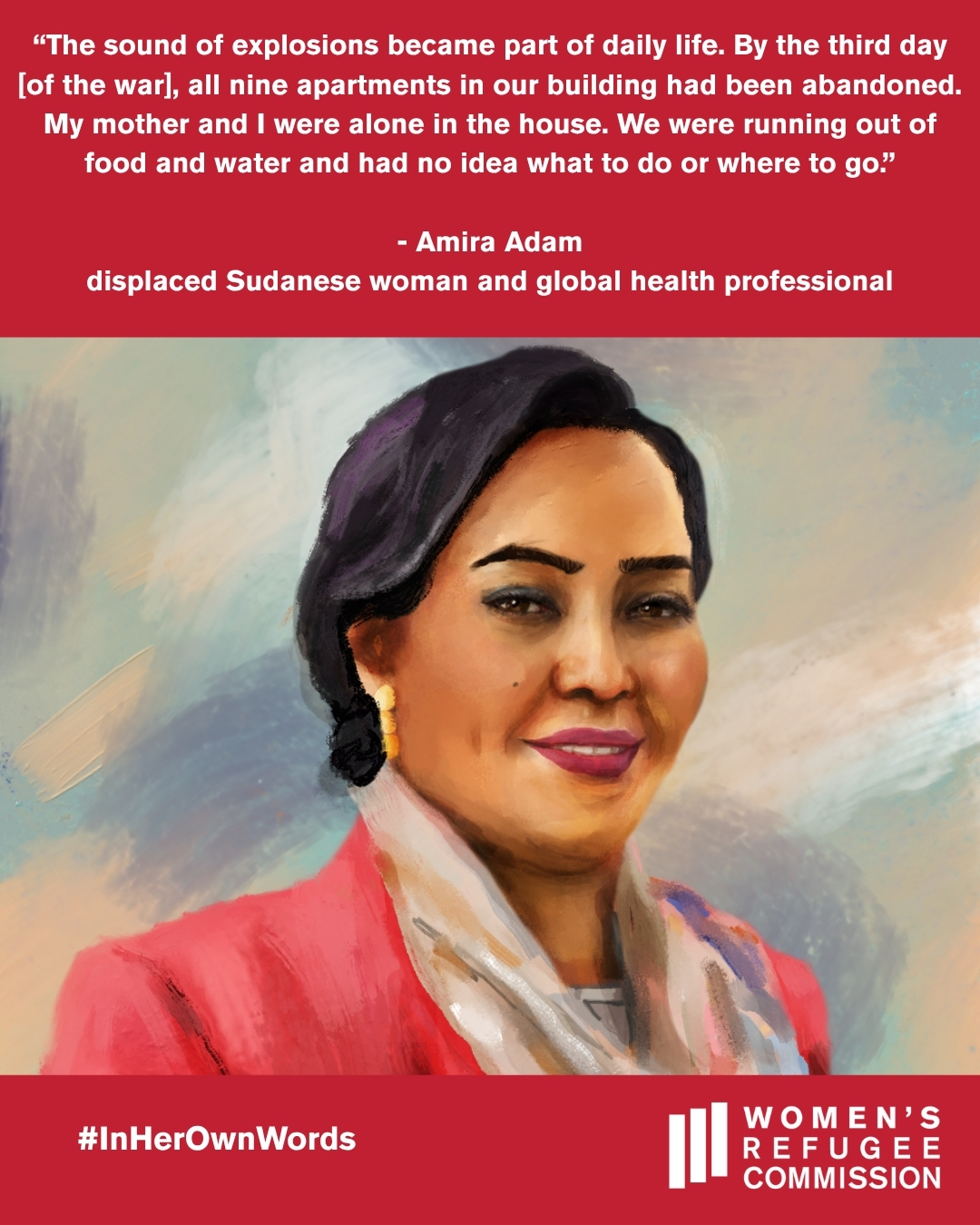
Amira Adam
Sudan
“The war began on Saturday, April 15, 2023, in the heart of Khartoum. I was working with WHO Sudan as the Team Lead for HIV, Hepatitis, and STIs. It was the middle of Ramadan.
I still remember waking up early that morning, hoping to get some writing done before meeting my team at the UNDP office. Around 9:00 a.m., when I was getting ready to head out, a friend called and told me not to come because there was armed fighting in southern Khartoum, and it was safer to stay home. That same friend ended up stranded in the UNDP office until the evening while her children were at home with their grandmother.
What began as fighting in one part of the city quickly spread across Khartoum, including to Khartoum North, where I lived. Near our home was a large RSF base that became a frequent target of military airstrikes, which were often met with anti-aircraft fire. The sound of explosions became part of daily life.
The days that followed are a blur. The electricity went out almost immediately, and the water supply stopped shortly afterward. My mother and I were alone in the house; the rest of our family was outside Sudan. We were running out of food and water and had no idea what to do or where to go. To make matters worse, my car was in the repair shop, limiting our ability to move.
By the third day, all nine apartments in our building had been abandoned. I remember receiving a call from my landlord, who lived downstairs. He told me that his family was leaving for their village and asked about my plans. I remember thinking, “What plans? I have no plans.” Eventually, I managed to find another apartment in what was considered a relatively safer part of the same neighborhood. My mother and I moved there, and all I could do was pray to make the right decision before it was too late.
A few days later, I received a call from the same friend who had warned me not to go to the office on the first day of the war. She told me that her family was renting a bus to travel to Egypt and asked if we wanted to join them. It felt as though my prayers had been answered.
Eight days after the war began, my mother and I boarded a bus bound for Egypt. The days leading to our departure were chaotic as we tried to fit our entire lives into a few suitcases. Like many others, we left believing we would be back home soon.
More than three years later, that return has yet to happen.
Arriving in Egypt felt like reaching a safe haven. My mother and I were fortunate to hold Egyptian citizenship, but many of our friends traveling with us did not. Despite this, they were treated with dignity and compassion and were allowed to enter the country rather than being returned to a war zone.
I particularly remember how some of the usual entry requirements, including proof of yellow fever vaccination, were temporarily waived to ensure that people fleeing the conflict could enter safely. At that moment, what mattered most was that we had escaped the violence and uncertainty and had found protection.
Sudan was no longer the home we had left only days earlier; it had become a place where our safety and freedom could no longer be guaranteed. Knowing that we would not be forced to return to an active conflict zone provided a sense of security and allowed us to begin rebuilding our lives in exile.
While very much welcomed during the early days of the war, Sudanese refugees are currently facing significant challenges in Egypt, including discrimination, anti-immigrant sentiment, and negative social media campaigns, as well as concerns around detention and forced deportation.
Though these are very real struggles for Sudanese refugees in Egypt, for many Sudanese families, the ability to cross the border and remain in safety was not only a legal protection but a lifeline.”
These are the words of Amira Adam, a Sudanese global health professional and WRC Humanitarian Futures Fellow. In commemoration of the 75th anniversary of the 1951 Refugee Convention, we invited her to share her reflections on the impact of the convention on her life and experiences.
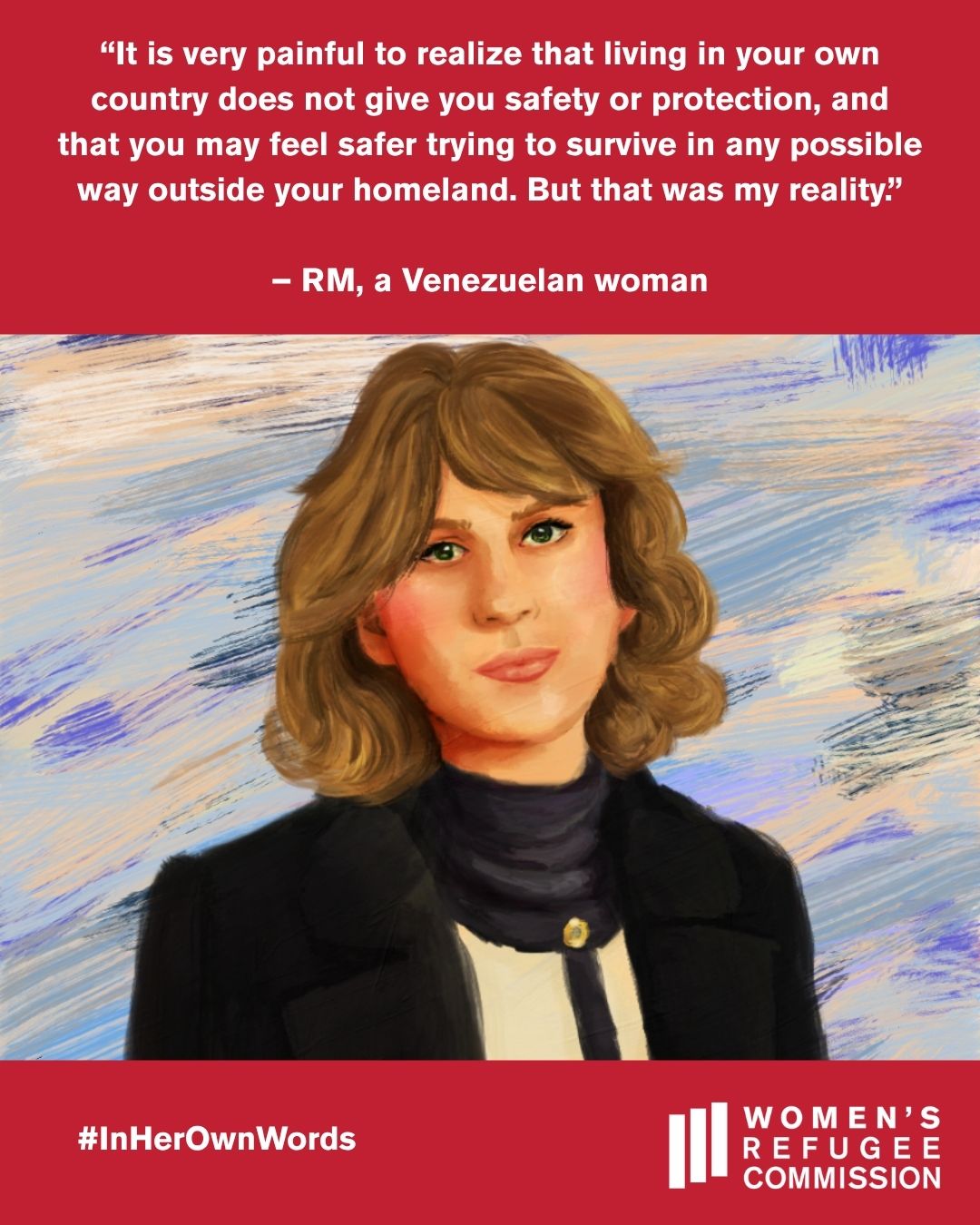
RM
Venezuela
“My journey as a displaced person began when I was 18 years old. I left my country with my family, hoping to find a better future that, sadly, my country could no longer offer me.
At that time, my biggest dream was to continue my studies, obtain a degree, and move forward with my life, like any person should be able to do under normal circumstances. It is very painful to realize that living in your own country does not give you safety or protection, and that you may feel safer trying to survive in any possible way outside your homeland. But that was my reality.
My new life in Mexico began with many difficulties. Even though non-discrimination is recognized as a right under the law, discrimination is still everywhere. It can be seen in people’s faces, in the way they speak to you, and in the way they treat you.
I had a very difficult time during my first years at university. Xenophobia and mockery because of where I came from became increasingly painful. I often asked myself: Why do people feel the need to make fun of this? Why am I afraid to say where I come from?
Furthermore, accessing decent work, or even any kind of work, can be very difficult while you are going through a migration process. One of the main challenges is that many private sector employers, at least in my experience in Mexico, do not understand that your documentation is valid for work. That lack of knowledge, combined with xenophobia, can make it almost impossible to find a job or even secure work that can help you survive and move forward.
As with work, the documentation of a person affected by forced displacement is often not well understood by educational institutions, especially private ones. Because of this, you often have to prove in every possible way that you are a human being who simply wants to access education or employment and claim a right that should already be recognized.
Self-reliance is important, but it must also be supported and guided. As a young person, you face barriers. As a woman, you face barriers. And as a refugee or displaced person, you face even more barriers. My own experience has shown me that if support is not provided, whether moral, financial, or simply through someone opening a door and offering that first opportunity, it becomes very difficult to achieve self-reliance.
Governments must ensure that written laws and rights are actually applied and do not exist only on paper. These legal frameworks, protections, and plans must be implemented properly. If they are applied with the same care with which they are written, they could have an incredible impact on the futures of refugee girls and women around the world.
Governments should also create more pathways that allow displaced women and girls to develop, grow, and become independent. Bureaucracy and legal systems should not become barriers. They should function as mechanisms of protection.
Refugee women and girls should not only be seen as highly vulnerable people. They should also be recognized as potential leaders and independent women who are ready to take control of their lives and contribute to their host countries.
Too often, we are seen only as numbers or as one more case. But in reality, we are people with dreams, aspirations, and the desire to contribute much more.”
These are the words of RM, a young Venezuelan women. In commemoration of the 75th anniversary of the 1951 Refugee Convention, we invited her to share her reflections on the impact of the convention on her life and experiences.
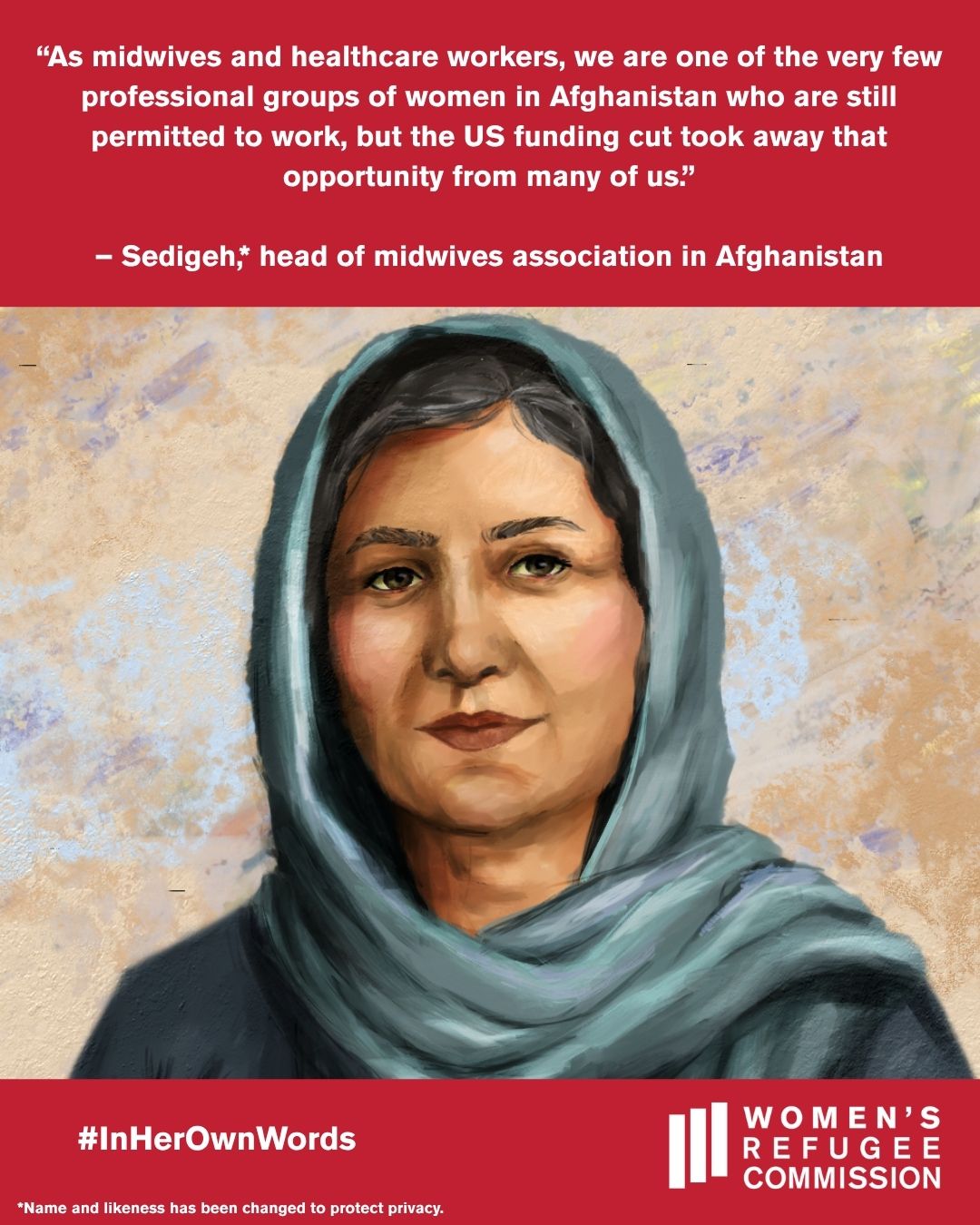
"Sedigeh"
Afghanistan
“My name is Sedigeh.* I am a midwife and the executive director of one of Afghanistan’s largest midwives associations. We are a membership-based association with 4,000 midwife members across the country and 30 female employees in the office. A huge part of our funding was from the US, focused on two projects.
In one project, we had 52 employees, midwives, who provided services to mothers. The midwives delivered 700 to 800 babies a month, and this was supported by our center. Around 2,000 mothers received services like antenatal, postnatal, and family planning there.
We had another project entirely funded by USAID. It was a capacity-building program in around 21 provinces of Afghanistan. The midwives there, especially in the very remote areas of Afghanistan, received training from experts and were paired with mentors. This program was unfortunately badly affected when we lost USAID funding.
So many women lost their jobs, and not only their jobs, but also the hope of quality care. Before the cuts, we had about 300 paid employees, mostly midwives. After the cuts we have about 200.
The biggest gap that we faced is mostly in terms of access to care in remote areas. … Around 152 remote health facilities closed. A huge number of women are disappointed to have lost services.
Our office is under lots of pressure and has lots of problems. We are operating, we run our activities, but it is difficult.
USAID was funding a hospital in Kabul in a neighborhood with 2 million people. It was the only hospital where women received delivery, antenatal, postnatal, and family planning care. Now, there are no midwives in that hospital.
To provide the quality of care that people need, we need resources.
When we had USAID funding, it not only provided services to the women; it was empowering women as well. As midwives and healthcare workers, we are one of the very few professional groups of women in Afghanistan who are still permitted to work, but the US funding cut took away that opportunity from many of us as well.”
Sedigeh* is an executive director of one of Afghanistan’s largest midwives associations.
Her organization works across 34 provinces in Afghanistan. We interviewed her for our joint report with Refugees International that details the devastating impact of aid cuts on women-led organizations serving displaced women and girls. Read it here.
*Name and likeness has been changed to protect privacy.
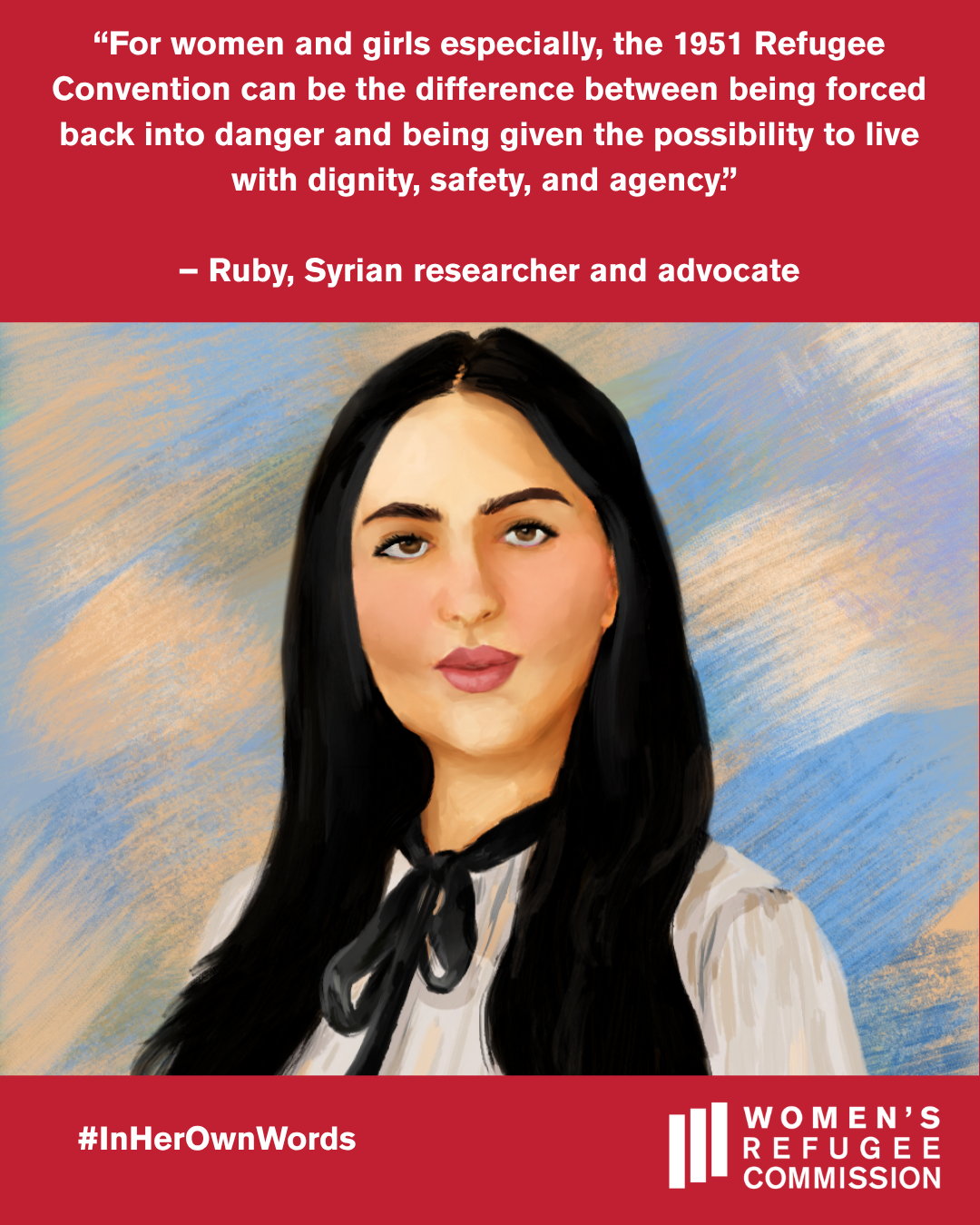
Ruby
Syria
“I had to leave Syria during the war. I was very lucky to receive a full scholarship to pursue my undergraduate degree at the American University of Beirut through the Tomorrow’s Leaders scholarship. This opportunity changed my life, but after graduation, I could not really stay safely or build a future in Lebanon. So, I left for Germany, where I was lucky to receive asylum, and with that came the right to live, work, study, and start rebuilding my life.
The 1951 Refugee Convention is not abstract for me. As someone who lived in Lebanon, a country that is not a signatory to the Convention, and then moved to Germany, a country that upholds many of these rights, I experienced the difference firsthand. For women and girls especially, the Convention can be the difference between being forced back into danger and being given the possibility to live with dignity, safety, and agency.
The principle of non-refoulement (a refugee should not be returned to a country where they face serious threats to their life or freedom) had a very direct impact on my life. In Lebanon, I did not feel that I had this protection in the same way, and I was always aware of the risk of being returned to Syria. In Germany, being protected from return to a country where I could face serious threats gave me safety and stability. It allowed me to start thinking about the future, not only about survival.
Education has been one of the most important rights in my life. Scholarships gave me the chance to continue my studies after displacement, first at the American University of Beirut and later at Cambridge University. Education allowed me to rebuild my future, but also to turn my lived experience into research, advocacy, and work that can hopefully contribute to change.
The right to work changed my life by allowing me not only to survive, but also to contribute. Being able to work gave me independence, dignity, and the possibility to continue my advocacy and research. It also allowed me to support myself and to be part of society, rather than being treated only as someone who needs help.
Freedom of movement has also had a huge impact on my life. It allowed me to study, work, participate in conferences, and join policy forums. It also enabled me to advocate for what I believe in, including gender equality, climate justice, and the rights of displaced people. For refugees, movement is not only physical. It is also connected to opportunity, voice, and dignity.
My own lived experience has shown me that protection is not enough if refugees are not also given the chance to become self-reliant and to shape their own futures. I am very grateful that, because of my advocacy and research, I was offered, on different occasions, a seat at the table to speak with policymakers, participate in conferences, and share my perspective.
But at the same time, I always wanted to remain connected to the grassroots. I kept volunteering and contributing to different women’s and climate organizations in Syria, even remotely. For me, this is very important because refugee women should not only be invited to share their stories. They should be part of shaping the policies, programs, and futures that affect them.
Self-reliance also means more than having a job. It means having education, documents, safety, freedom of movement, and the possibility to imagine a future. It means not being reduced to victimhood, but being recognized as someone with knowledge, agency, and leadership.”
These are the words of Ruby, a Syrian researcher and advocate interested in gender equality and the intersections of peace and security, climate justice, and displacement issues. We invited her to share her reflections on the impact of the 1951 Refugee Convention on her own life and experiences.
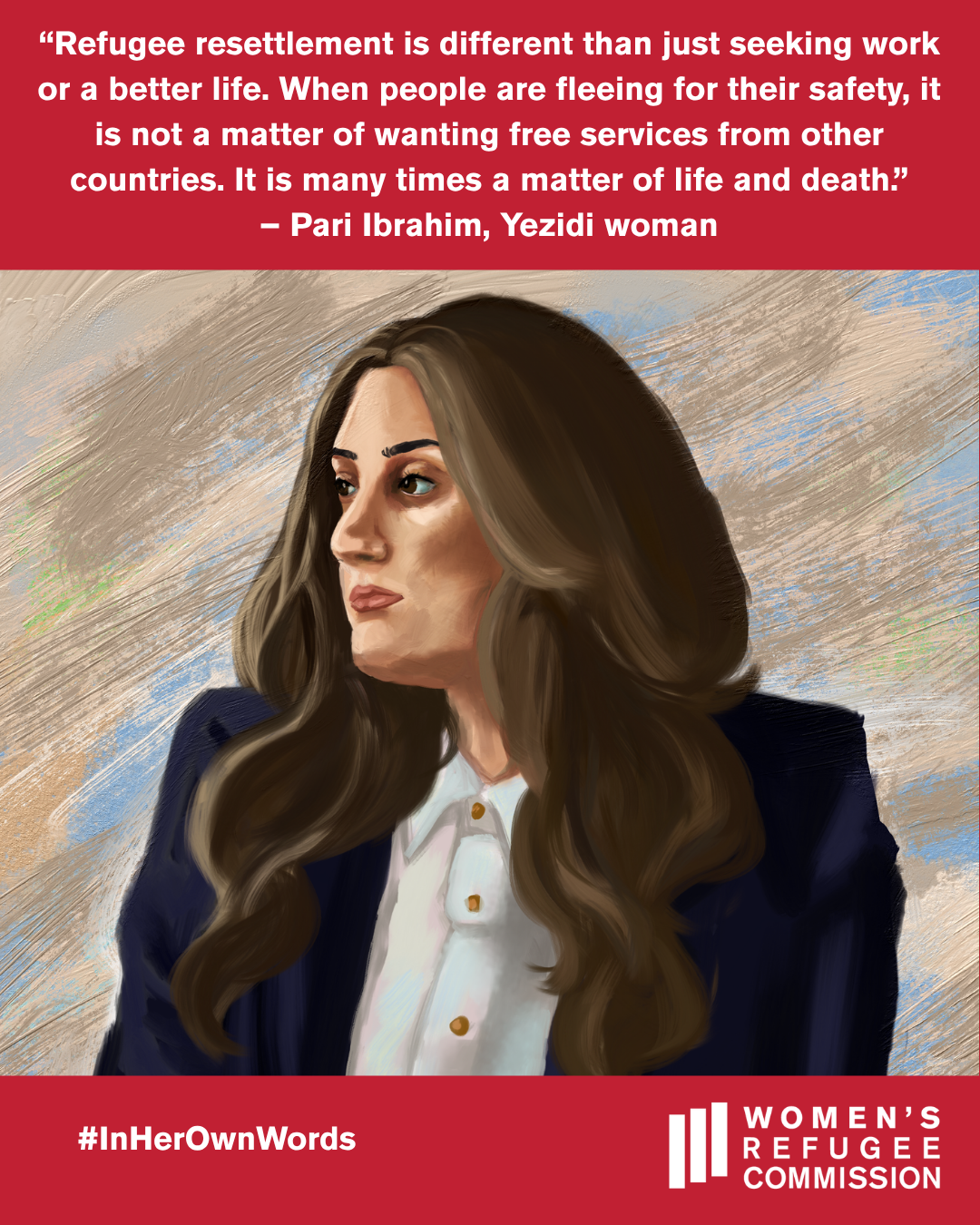
A Yezidi Activist
Originally from Iraq
“I am a Yezidi woman originally from Iraq. My family fled from the Saddam Hussein regime when I was two years old. We traveled by foot from Iraq to Turkey, through the mountains. I do not remember those details, since I was very young. We lived in a refugee camp in Turkey for one year, and then we were brought to the Netherlands as political refugees. I value the culture and education that I have from my community, the Yezidis, and also Dutch values and education, although it was challenging for me and my family to settle as refugees in a foreign country.
Our family benefited from being refugees in the Netherlands in many ways. Most importantly, we were safe from the threat of violence. Secondly, we benefited from education, which has allowed me to speak several languages and interact with more people than I would have been able to if I always lived in Iraq. Thirdly, it gave us a chance to contribute to our community back in Iraq from a place of safety and less political pressure.
While resettlement had many benefits, I would say that I and my family did experience some discrimination as refugees and foreigners. In some ways, such as being a student in school or looking for work, we felt like outsiders, and that was a challenge.
I believe education is a primary need, aside from food and shelter, for smaller or vulnerable communities. With education, doors are open, and without it, life is extremely hard to navigate. Our people in Iraq have always been on the outside, denied the basic education and higher education opportunities available to others. Having a good education has changed my life and, I am sure, the lives of many other refugees.
The right to freedom of religion is the most important right for us, as Yezidis. Since we are not Muslim, we have been attacked constantly for many centuries by every group that held power in our part of the world. Many people, not only ISIS, want us to be eliminated and do not believe we should exist or have any rights. But freedom of religion cannot be for one group or another. It has to be for everyone.
Justice is also a top priority for me, personally, because of some of my experiences. It is important that everyone, especially women and girls, are fairly considered in any justice system. For the Yezidi community, the absence of justice is just unacceptable. After the worst crime, genocide, was committed against our people, we cannot accept moving forward without meaningful accountability. That means justice in courts, prison sentences, and a transitional justice plan that actually means something to Yezidis.
Refugee resettlement is different than just seeking work or a better life. In our experience, we were very much aware of serious threats to safety. And indeed, several times since we left, our people have suffered horrible violence. In 2007, Al-Qaeda killed many hundreds of Yezidis in a truck bombing. In 2014, ISIS killed thousands of men and older women, and they abducted more than 6,000 women and children, who were then enslaved and suffered unimaginable brutality. During the Saddam Hussein era, Yezidis suffered in different ways. So when people are fleeing for their safety, it is not a matter of wanting free services from other countries. It is many times a matter of life and death.”
These are the words of Pari Ibrahim, Executive Director of the Free Yezidi Foundation.
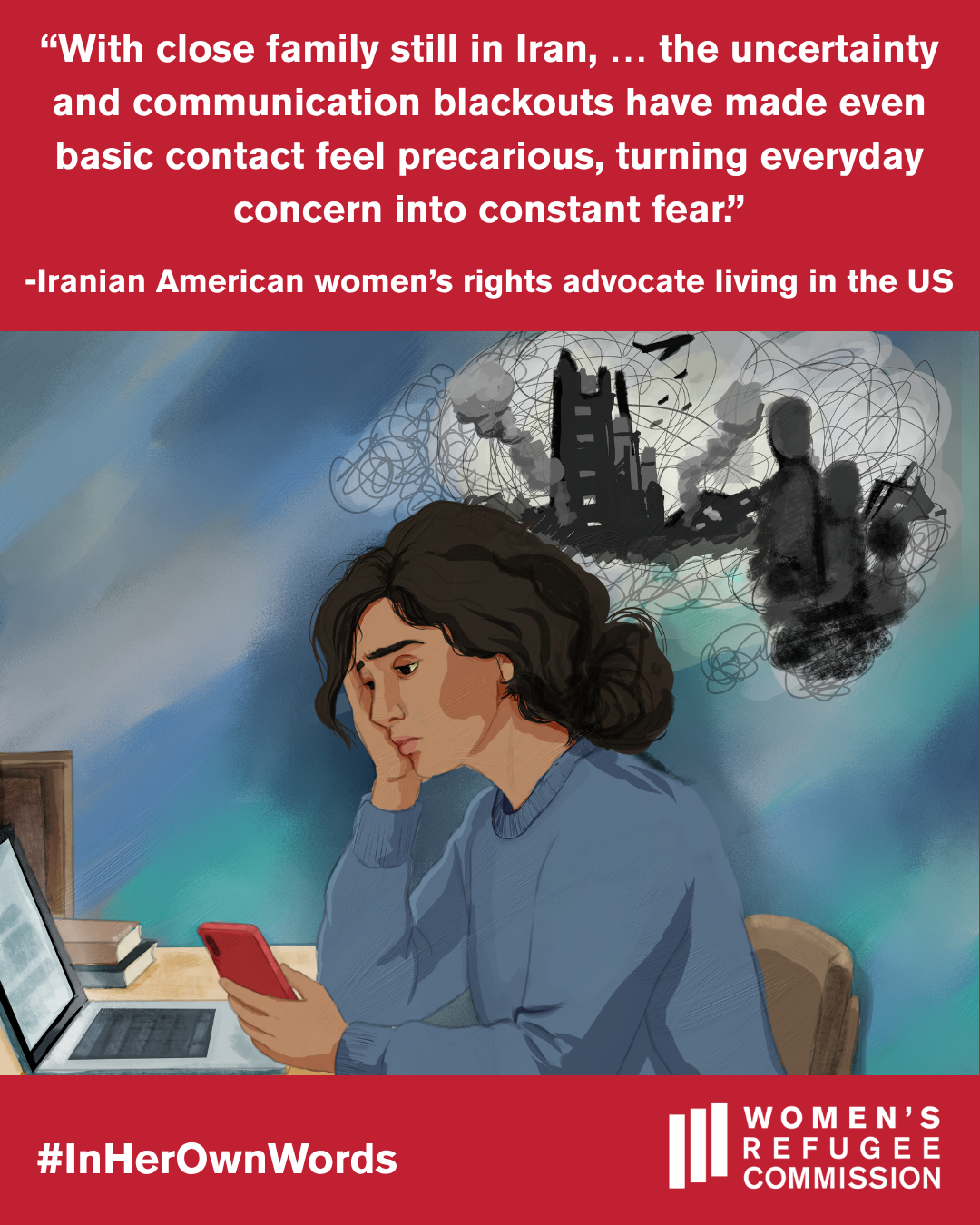
Women's Rights Advocate
United States
“I am an Iranian American women’s rights advocate, with close family still in Iran. In recent weeks, the uncertainty and communication blackouts have made even basic contact feel precarious, turning everyday concern into constant fear. Living between contexts brings its own tension—trying to remain engaged and informed while knowing that those inside the country face risks that I do not, and that even speaking can carry consequences for loved ones.
At the same time, the crisis has deepened divisions across the diaspora, adding another layer of emotional strain in a moment that already feels overwhelming. What remains constant is the disproportionate burden on women inside Iran, who are navigating insecurity, caregiving, and restricted access to information under increasingly constrained conditions.
What is needed most is a deeper recognition of these layered realities, so that the experiences of women, alongside broader impacts on families and communities, are not flattened or overlooked in how this conflict is understood—especially when access to information, safety, and connection are already so fragile.”
These are the words of an Iranian American woman living in the US, who works as a women’s rights advocate with an organization that partners with WRC. We invited her to share her perspective on how the wars in Iran and Lebanon have impacted women like her, as well as how they have impacted the work of women-led organizations.
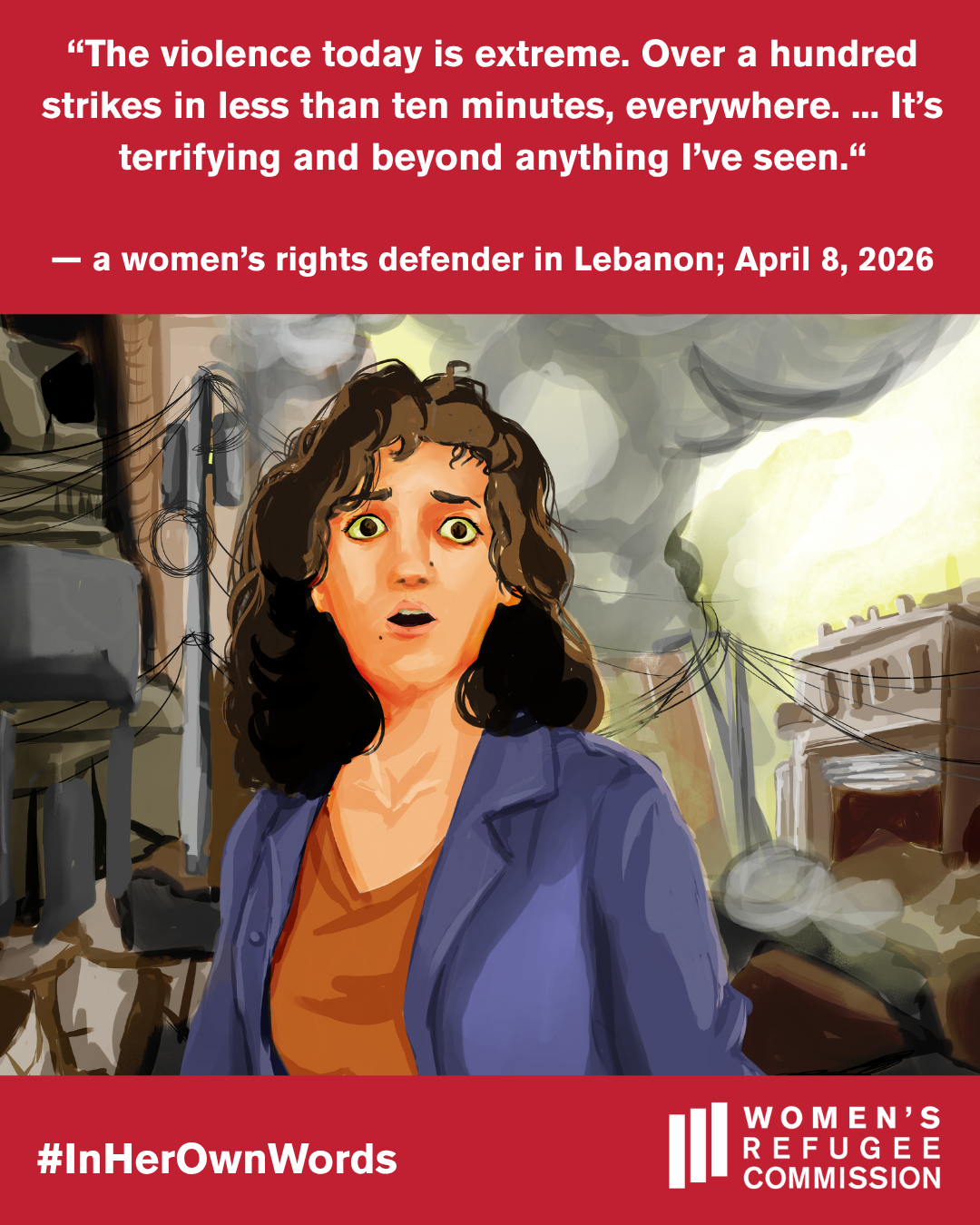
A Women's Rights Defender
Lebanon
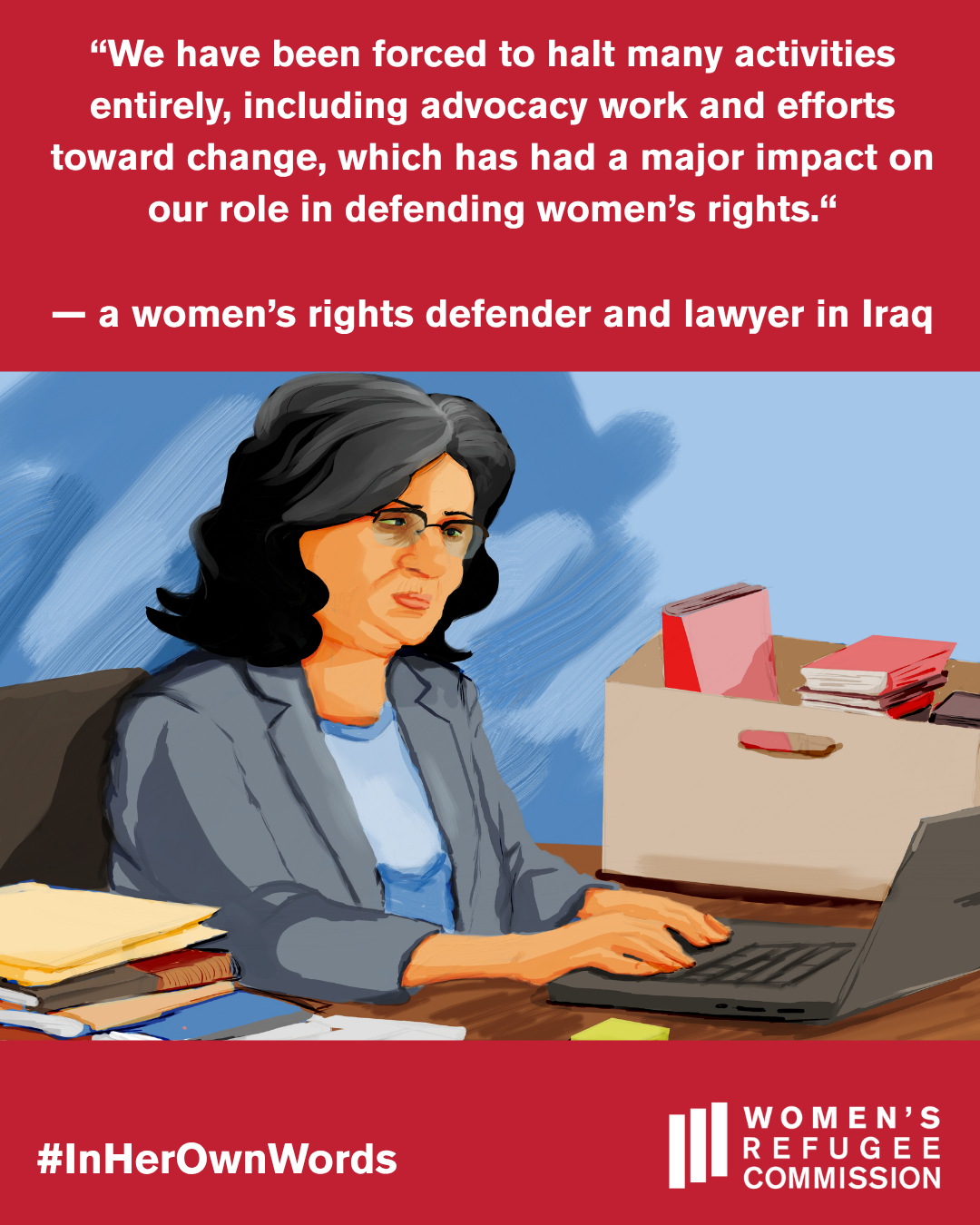
A Women’s Rights Defender and Lawyer
Iraq
“I am a widow, working in the legal field as a lawyer, a civil society activist, and a defender of women’s rights since 2004.
I experienced internal displacement with my family in 2006 due to security conditions and sectarian conflict, when we moved from Baghdad to Sulaymaniyah. I continue to move between Sulaymaniyah and Baghdad due to work requirements, with access to housing in Baghdad when needed.
Since 2004, I have lived in a state of instability due to the security situation and the risks associated with my work in defending human rights, especially women’s rights. I rely on my income from my role as the head of a civil society organization, in addition to my work as a lawyer. I live with my children as a widow, residing in a home belonging to one of them, as it is difficult for me to live independently under the current conditions.
My life has undergone significant changes [since the start of the war in Iran and Lebanon], particularly with the increasing targeting of prominent female figures, including women leaders, heads of organizations, and activists.
This targeting has taken the form of defamation and smear campaigns, which have negatively affected our work and reduced our presence in the public sphere. We have been forced to halt many activities entirely, including advocacy work and efforts toward change, which has had a major impact on our role in defending women’s rights.
As women activists, we face additional risks compared to men, most notably personal and social targeting and defamation. This reality has limited our participation in public activities and weakened our role in influencing and driving change, especially on issues related to women’s rights.
What I aspire to most is a sense of safety and stability that would allow me to return to work in a secure and effective way. I hope to reactivate activities and projects that serve women and girls, particularly the most vulnerable groups. I also seek support for the organization I work with so it can regain its activity and influential role in society, helping it reach a larger number of women in need of support.”
These are the words of a woman in Iraq who works as a women’s rights defender and lawyer with an organization that partners with the Global Campaign for Equal Nationality Rights, housed within WRC. We invited her to share her perspective on how the war in the Middle East is impacting women like her, as well as how it is impacting the work of women-led organizations.
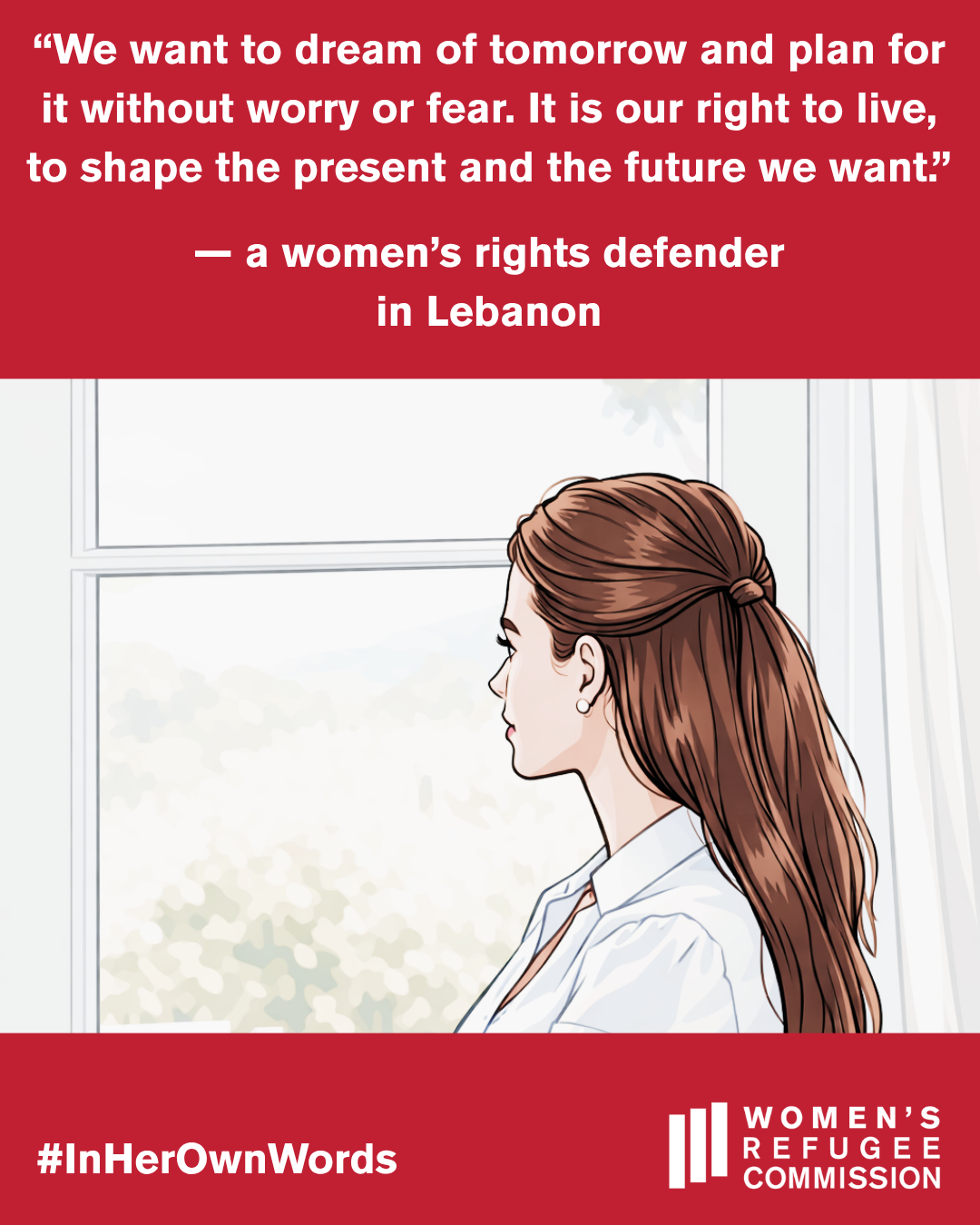
A Women’s Rights Defender
Lebanon
“Before the crisis began, my life was full of activity and intensive work. … We moved constantly between the office, conference halls, meetings with decision-makers, and press conferences, drafting statements, processing paperwork for those affected by discrimination under nationality laws, receiving complaints, and striving to find solutions for children, young men and women, mothers, and spouses. And then, after a long and full day, we would return home to safety. Despite the challenges, [we lived] with a deep hunger for work, as long as there was hope for change, for supporting the oppressed, and for achieving justice.
Since the beginning of the crisis, our lives have changed radically! Danger has become both expected and unpredictable, … chasing us like a shadow, threatening our lives and the lives of civilians everywhere. … Even daily movement from home to the office has become filled with risk and threat, [due to bombing].
What we witness on the ground is far beyond what can be conveyed through screens. On the roads, during halted traffic, I have seen scenes of displacement that are deeply heartbreaking—children with frozen, uncertain eyes, and women carrying what little they could gather of their lives in a single bag. It leaves you questioning: can a single bag ever replace a home?
Our legal projects, awareness campaigns, and the videos we prepared … have all been put on hold. … I feel that women’s efforts, their rights, and their concerns have been disrupted, while we face decisions of war and peace being made without regard for the continuous work we have carried out in pursuit of justice and equality.
All of this has made me feel profoundly helpless. … I fear that the rights we have worked to achieve will become seen as luxuries, dispensable, and that many human rights and feminist organizations will be reduced to providing only relief services, instead of sustaining meaningful advocacy, citizenship, and real justice.
I hope that women and girls can live freely and safely, and participate in decision-making without fear or restrictions, and that every family can have a secure and stable psychological and social environment. I want the conditions to allow us to continue our campaigns and legal and awareness initiatives without disruption caused by conflict, so that the efforts made for rights and equality remain real and lasting. … We want to dream of tomorrow and plan for it without worry or fear. It is our right to live, to shape the present and the future we want, and to build a justice that is worthy of us all.”
These are the words of a woman in Lebanon who works on behalf of women’s rights for an organization in Beirut that partners with WRC. We invited her to share her perspective on how the war in Lebanon is impacting women like her, as well as how it is impacting the work of women-led organizations.
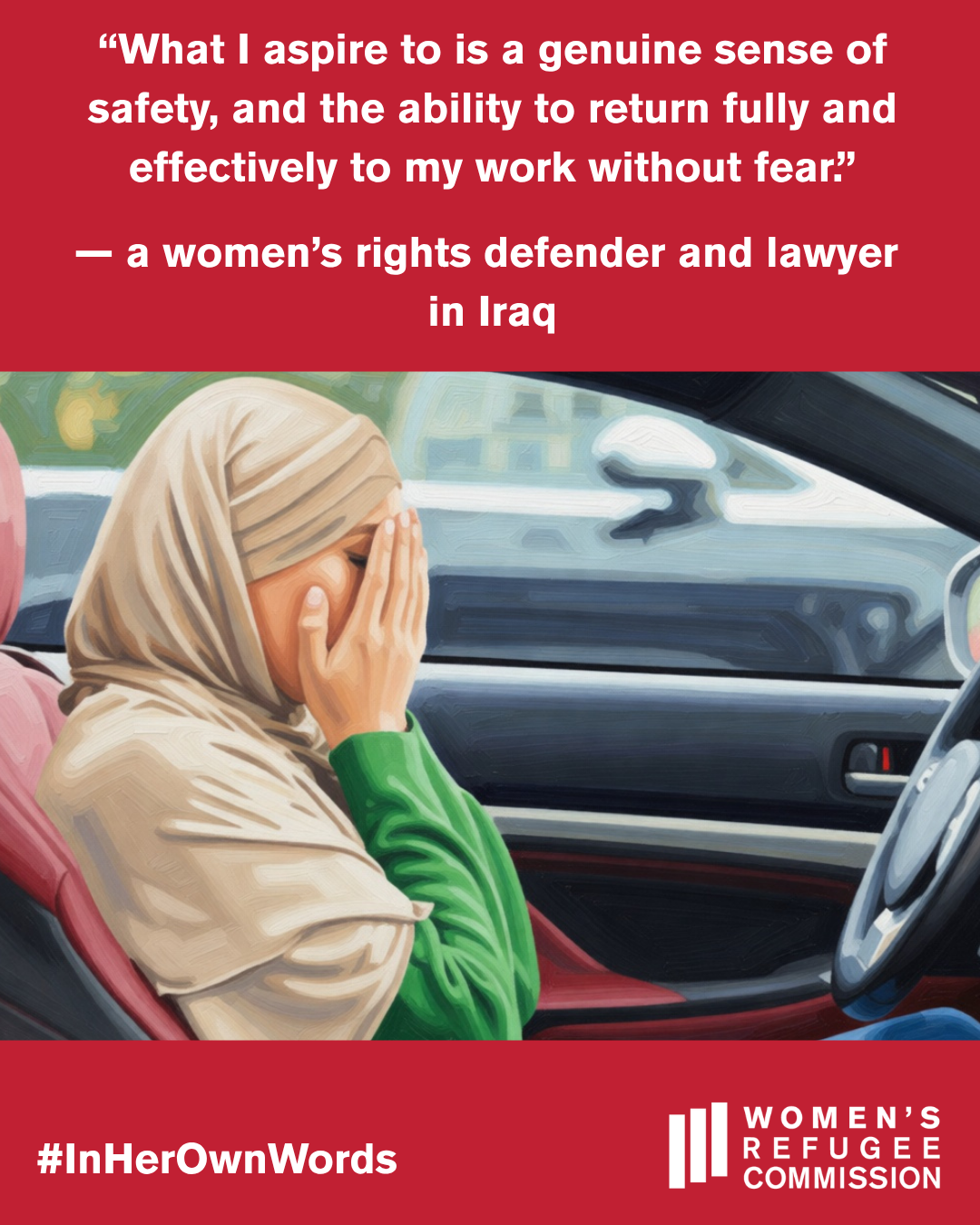
A Women’s Rights Defender and Lawyer
Iraq
“I am a lawyer and a civil society activist, and I have been working for years to defend women’s rights. I am married and have a young daughter, and I constantly strive to balance my family responsibilities with my role in serving the community.
Before the crisis, my life was more stable. I practiced my work as a lawyer and actively participated in activities and projects that support women. I had a stable source of income that helped me provide for my family’s needs. We lived in our home normally, with a relative sense of safety and stability.
Today, however, many things have changed. Although I have not permanently left my home, I am sometimes forced to leave it temporarily due to the security situation, especially with the targeting of certain leaders and activists or when incidents occur close to where we live. Each time, I live in a state of anxiety and tension until I am able to return home.
As women activists working in the field of women’s rights, we face compounded challenges. In addition to the security situation, there are social pressures and risks linked to the nature of our work, which have forced us to reduce our activities, and in some cases stop them entirely. This disruption has not only affected us as activists, but also the women and girls who relied on these programs for support and assistance.
On a daily living level, the situation has become more difficult due to the economic decline, rising prices, and shortages of certain essential goods, especially those related to children. This increases the daily burden on me as a mother.
Despite all these challenges, I still believe in the importance of continuing. What I aspire to is a genuine sense of safety, and the ability to return fully and effectively to my work without fear. I also hope to resume our projects aimed at supporting women and girls, because this work is not just a job for me, it is a mission I believe in and strive to fulfill.
We need a safe and supportive environment that allows us to continue our work, serve our community, and reach the women who need us most, those who are still waiting for someone to stand by their side.”
These are the words of a woman in Iraq who works as a women’s rights defender and lawyer with an organization that partners with the Global Campaign for Equal Nationality Rights, housed within WRC. We invited her to share her perspective on how the war in the Middle East is impacting women like her, as well as how it is impacting the work of women-led organizations.
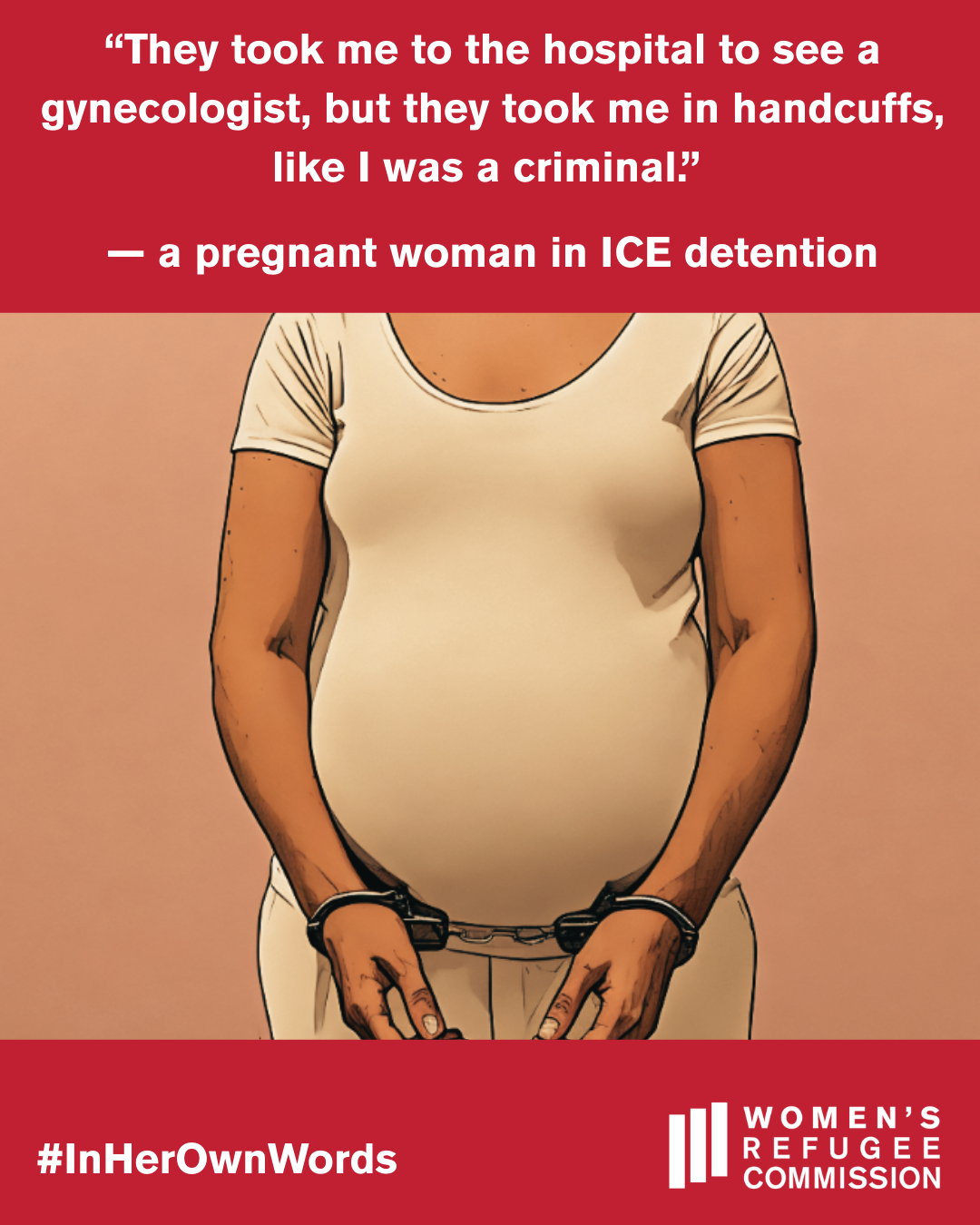
A Pregnant Woman
In ICE Detention
“Two days ago, they took me to the hospital to see a gynecologist, but they took me in handcuffs, like I was a criminal.
“And while they were examining me, the guards didn’t leave; they just stayed there. They sent me to take a urine test, and do you know what they did? They tied one of my hands to a pole in the bathroom, and with the other I had to hold the urine container, and the guard was standing outside with the door open. It would have been better not to have gone. […] It was really awful.”
These are the words of a woman who was pregnant while in US immigration detention. She was interviewed by researchers from WRC and Physicians for Human Rights (PHR) following her deportation from the US to Honduras.
Of the seven pregnant or postpartum women with whom the team spoke, she was the only one who received prenatal care while in detention.
She was placed in shackles throughout her medical appointment, including in the examination room and while giving a urine sample. She also reported being constantly surveilled by ICE officers, who were physically present in the examination room and the bathroom. Her story, as well as those of other detained pregnant women and deported parents, are featured in our report on family separation among parents deported to Honduras.
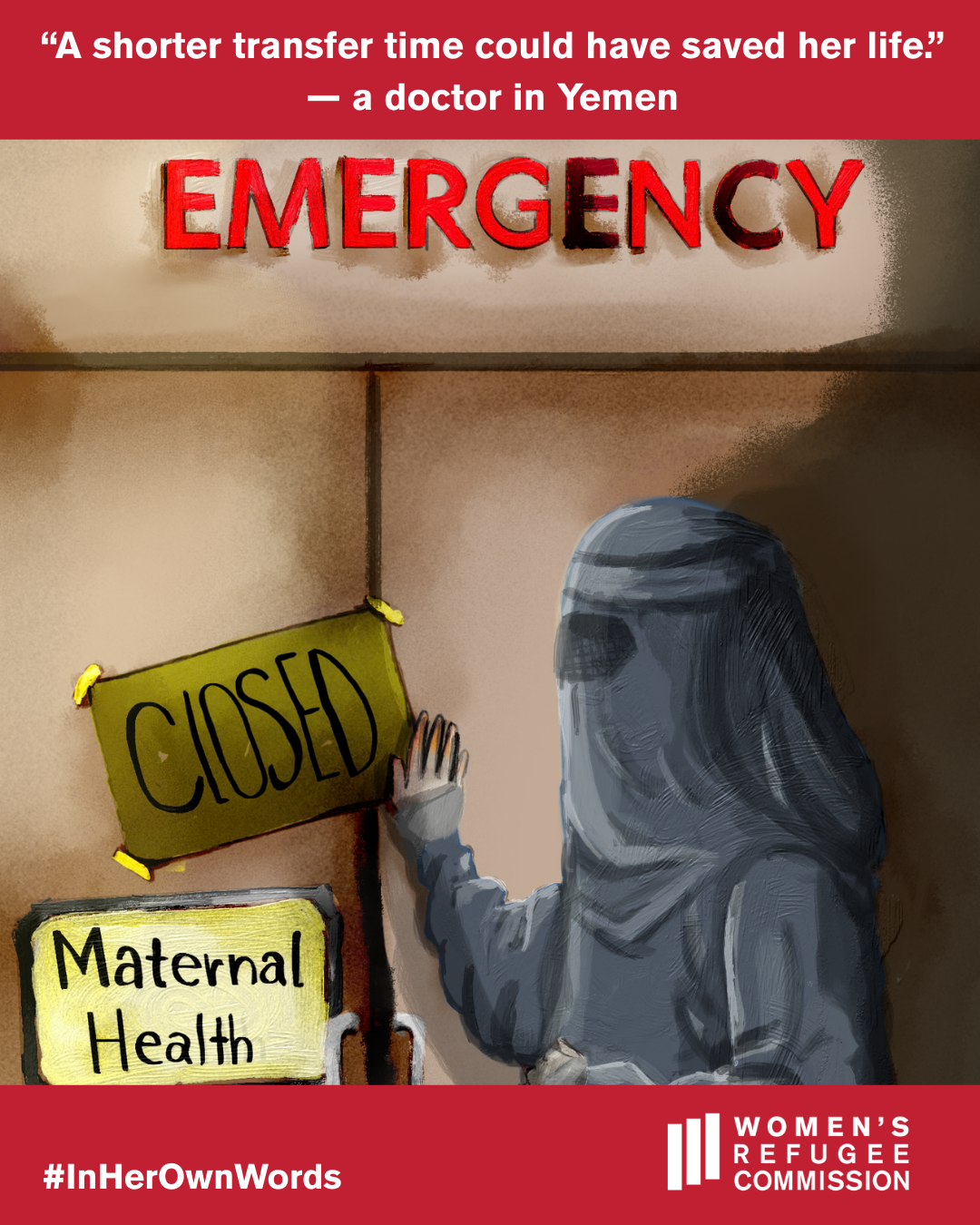
A Woman Doctor
Yemen
“A shorter transfer time could have saved her life. When [the midwife] told me, I was shocked and cried. As women, we put ourselves in her place. She left behind two daughters—it’s truly tragic. A mother’s departure is not just the loss of children or a husband, but the disintegration of an entire family. It’s very difficult, a soul is lost.”
These are the words of a doctor in Yemen, describing to a Guardian reporter the death of a young woman named Fatima, who died on the way to a hospital 1.5 hours away when her nearby hospital lost US funding and could no longer offer emergency obstetric care.
US foreign aid cuts have closed mobile clinics, family health houses, and camp hospitals—often forcing women to travel dangerously far to access lifesaving care.
Read more about the impact of these cuts in WRC’s report, A Year of Harms.
19 Year-Old Woman
Democratic Rep.of Congo
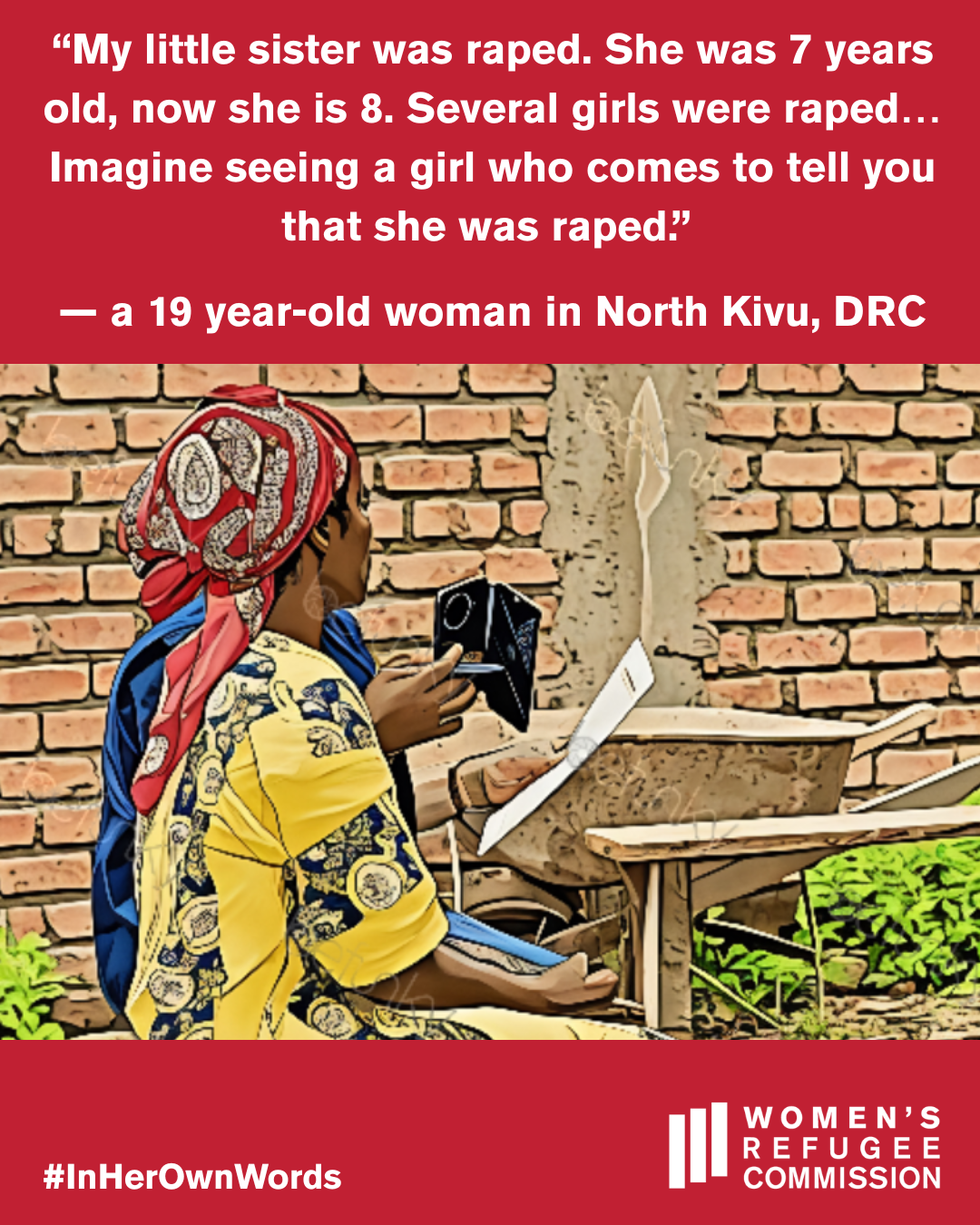
“I am 19 years old and studied up to the second year of secondary school. I have been moving since October 2024, when we left Bambiro and we settled here in Rukoko. [Note: names of locations have been changed to protect women’s identity.] During the invasion, my mother was shot as we were fleeing. Our big sister came to tell us: Mom was shot, and she died on the spot. We had no way to transport her body along with all our luggage. We organized a mourning for Mom, then after a month, my father also died. I don’t know if it is because he was thinking too much about the war and about Mom.
My little sister was raped. She was 7 years old, now she is 8. Several girls were raped… Imagine seeing a girl who comes to tell you that she was raped. There was a hospital that treated all these victims, but it was just a tent, set up in the camp for internally displaced people. My sister was treated there, too.
Now we are living with our big brother and his wife, but they no longer have work. My sister-in-law used to sell fish in the camp market, which was destroyed by the M23. After the camp was destroyed, my older brother rented a small house and that’s where we all live with my older sister and our older brother’s family. There are nine of us in the family.
The needs are enormous, especially for finding work and going to school. Take me, for example, if I could just find someone who would help me with my studies, I could go back to school. Or if I could find some money and sell some things, I could use the money to go back to school.”
These are the words of a young woman in the Democratic Republic of Congo (DRC) who was forced to flee her home due to an escalation of violence. WRC interviewed her for our new report on how renewed conflict combined with humanitarian funding cuts have impacted internally displaced women.
"Susan"
Sudan
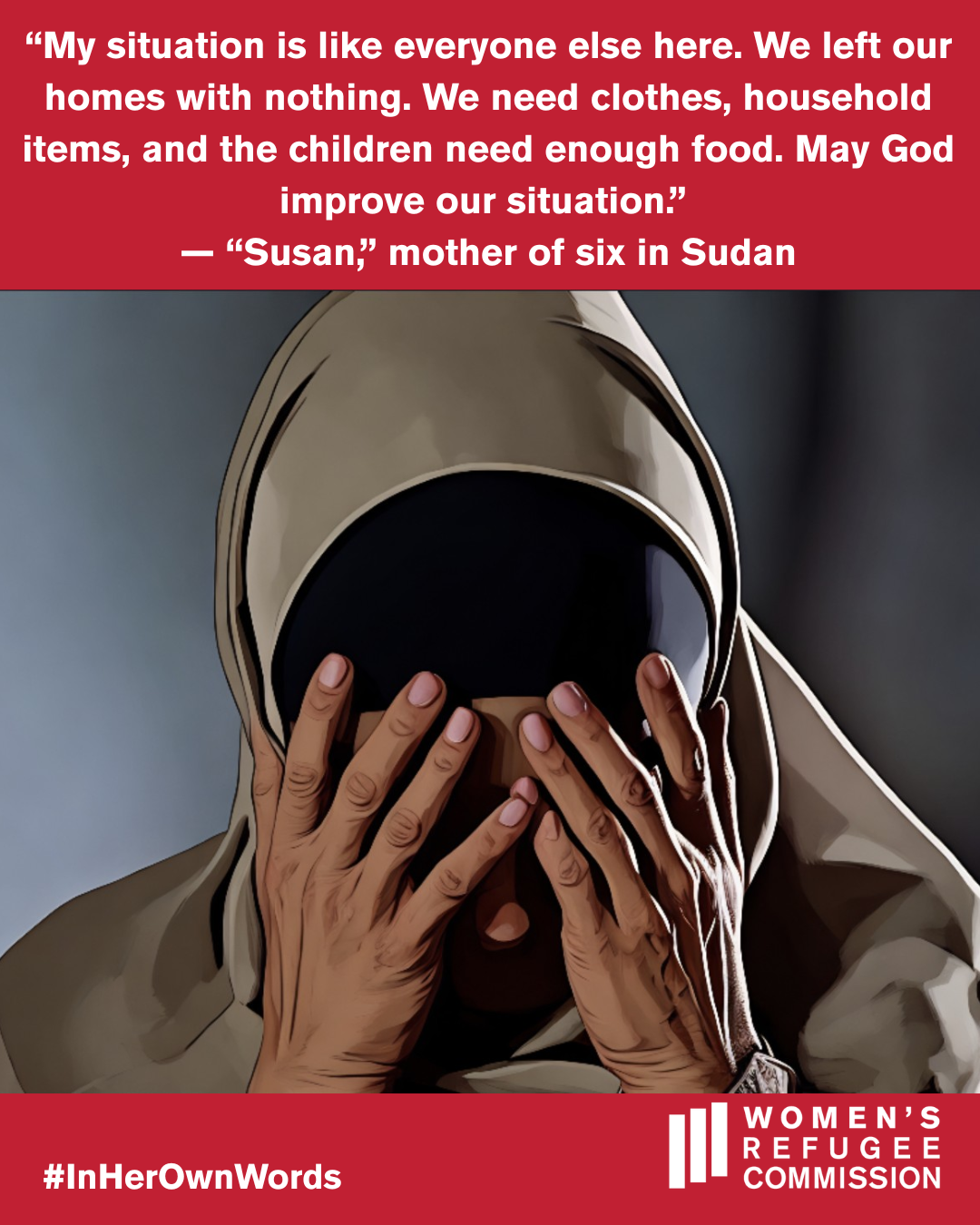
“I am 35 years old, from the Al-Jazeera state. Before the war, we were safe. I worked for a while selling tea and then became a housewife after marriage. My husband works as a farmer. Thank God, I was living well; we had everything we needed.
I have had a disability in my legs since I was three years old (I had polio), and I have undergone several surgeries. Thank God, I can now move, but only for short distances.
One day [after the war broke out], the Rapid Support Forces entered the house asking for the car keys. We told them we did not have cars, so they left us. On the morning of the second day, we fled to the Sheikh Al-Samani area, as it is a safe area. We have six children, and we fled together with our small family, but the rest of my relatives are still there in the war zone.
After five months, the area was bombed. [With] the worsening of the situation, we were forced to flee to Port Sudan. In Port Sudan, we stayed on the street a long time waiting to be assigned to one of the shelters. Good-hearted people provided us with food and drink, but the straw huts we were in could not withstand the rain. We have been here for about 15 days now and we receive one meal a day.
My situation is like everyone else here. No one is working. We left our homes with nothing. We need clothes, household items, and the children need enough food. May God improve our situation.”
These are the words of a woman in Sudan who was forced to flee to different parts of the country with her family, multiple times because of the war. WRC interviewed her more than a year ago for a report that showcases the stories of 22 internally displaced and refugee Sudanese women from all walks of life. Today, the conflict in Sudan is escalating to new extremes, with the RSF’s takeover of El Fasher, following a 500 day siege, leading to mass atrocities—including reported rapes, mass killings, and the massacre of 500 people in a maternity hospital.
Mother of 9 Children
Democratic Rep. of Congo
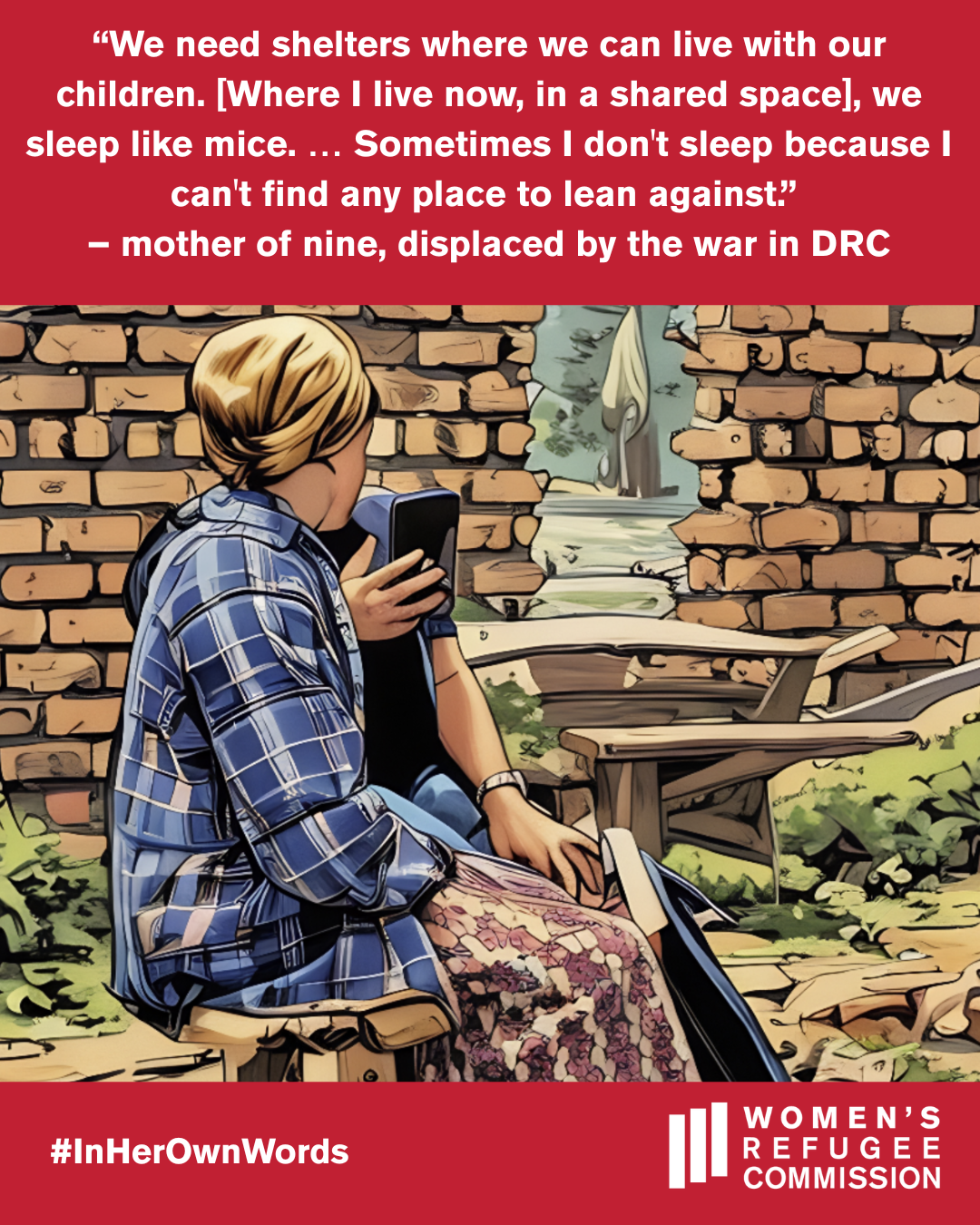
“I am 45 years old and I come from a village in South Kivu. For work, I washed gold and my husband looked for gold. I was drawing water to wash gold [one day], and suddenly my husband was killed [in front of me].
I fled to another village, where everything I had was looted, so I fled again to Bukavu with my 9 children. The eldest is 23 years old and the youngest is two years old. There was nowhere to live, so that’s how I came to live with my children in the house of an acquaintance. My children have nothing to eat and do not study. [There are] many difficulties and hardships that pain me. We women have many problems. We who are widows and displaced, we need shelters where we can live with our children. [Where I live now], we sleep like mice. We put out the fire and tidy up the kitchen to find somewhere to sleep. Sometimes I don’t sleep because I can’t find any place to lean against. May this war stop, I pray that God gives us peace.”
These are the words of a woman in the Democratic Republic of Congo (DRC) who was forced to flee with her children because of the war. WRC interviewed her for our report on how the conflict has impacted internally displaced women.
H.H.
Sudan
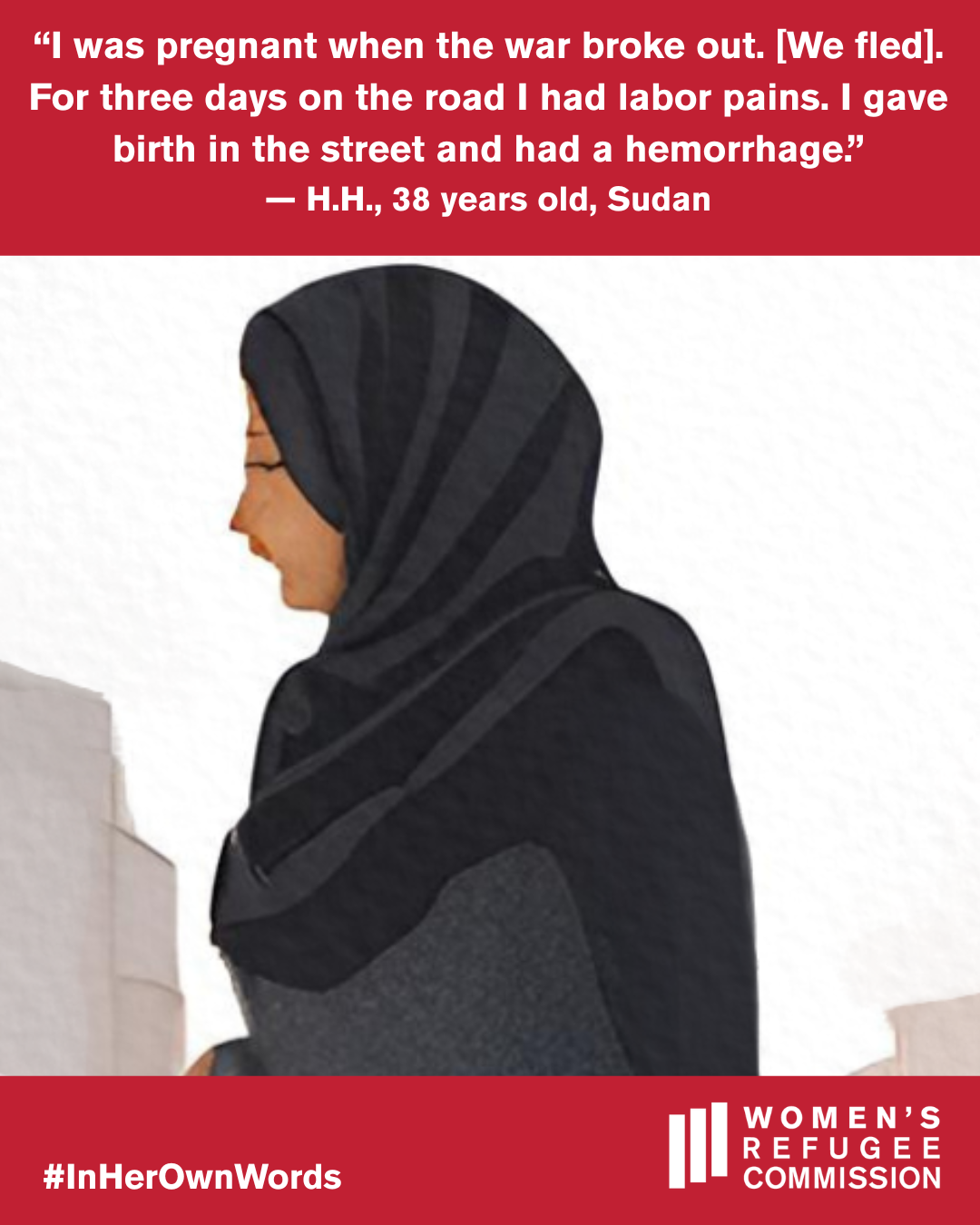
“I was pregnant when the war broke out and we moved to the White Nile. For three days on the road I had labor pains. I gave birth in the street and had a hemorrhage. I was taken to Al-Qatana Hospital. [When] I left the hospital and arrived in Kosti, we were received in a shelter center.
I fell ill and was diagnosed with diabetes and high blood pressure. The newborn girl suffered from a hole in her heart that was discovered in one of the follow-ups at the mobile clinic inside the shelter center. Now she has been transferred to the Kosti Cardiac Center, and she needs an operation.
I [also have] a little girl who suffers from severe anemia. Before the war in Khartoum, she used to get blood. Now I don’t have money for treatment.
I hope to be funded so that I can start a business project that will allow me to provide treatment, food, clothing, and a visit to a cardiologist.”
These are the words of H.H., a woman in Sudan who was forced to flee with her family at the outbreak of war and now lives in a shelter for displaced people. WRC interviewed her for our report about the impact of the conflict in Sudan on internally displaced and refugee women.
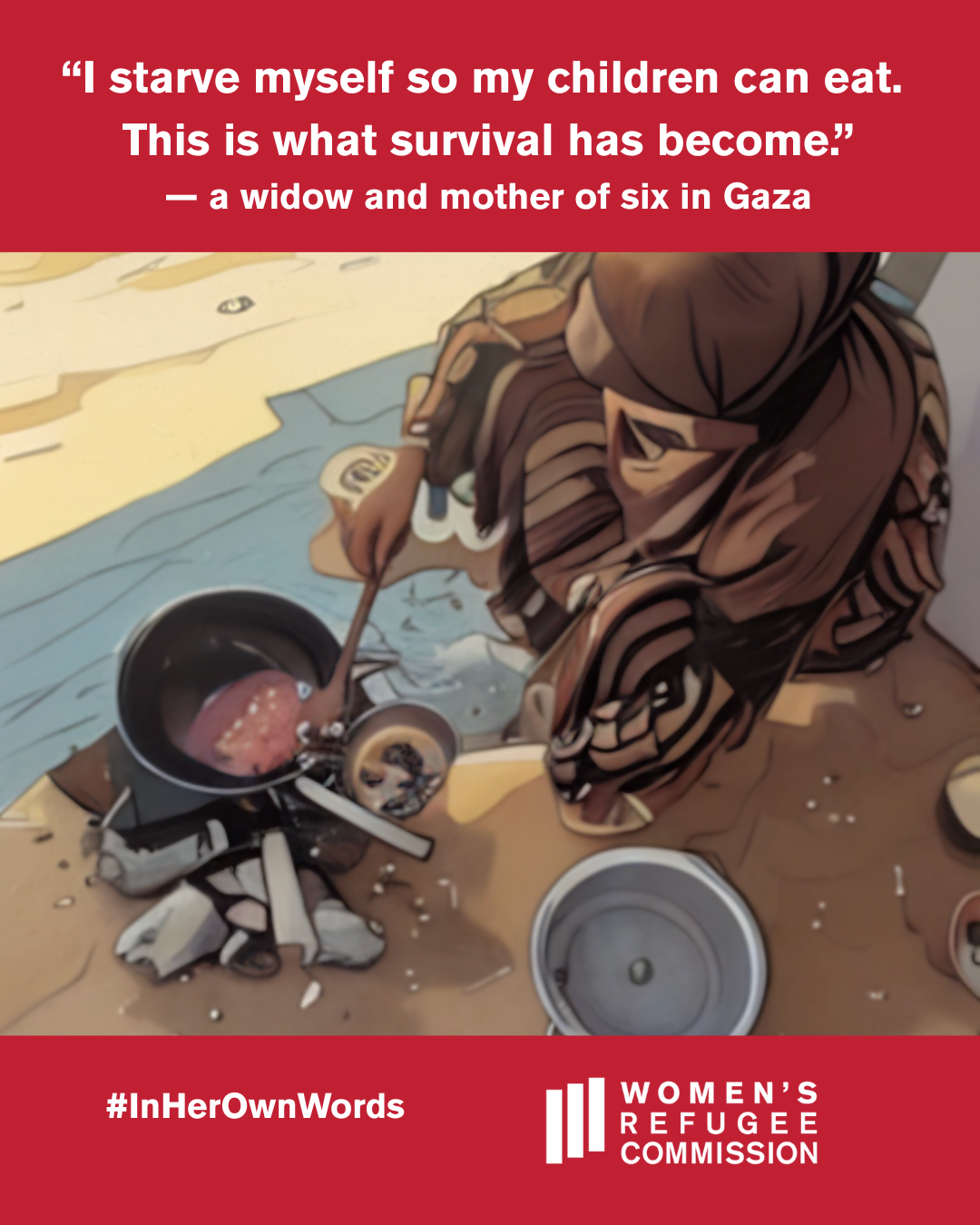
Mother of 6 Children
Gaza
“Most days we eat once, sometimes not at all. My younger children cry through the night and I have no answer for them. We have no gas or electricity, so I cook over scraps of wood or cardboard in old tins. The smoke makes us cough and sick, but there is no other way. I have grown frail and malnourished. I starve myself so my children can eat. This is what survival has become. The children are traumatized. They no longer ask about school, they only ask if they will eat tomorrow. Every attempt to get food feels like another wound. Recently I walked for hours to reach an aid distribution point. There were thousands of desperate people, crying and pushing while soldiers fired in the air. When I finally reached the front, everything was gone. I came back to my children empty-handed. My dreams are not complicated. I want my children to be safe, to eat until they are full, to return to their studies, and to grow up with dignity.”
These are the words of a woman in Gaza—a nurse, widow, and mother of six doing everything she can to keep herself and her children alive in the famine, while under constant siege.
This woman shared her story with WRC researchers for our report documenting the gendered impacts of food insecurity and famine in Gaza. In addition to first-person testimonies from eight women in Gaza, the report shares research findings and recommendations for governments, international bodies, and humanitarian actors. The women and girls of Gaza urgently need a ceasefire and humanitarian relief.